
It started with a photo.
I sat beside my grandmother, her soft hand clasping mine. With her other hand, she pulled a photograph from her sweater pocket and handed it to me. “Look at this,” she said in her thick Eastern European accent. “I was given this by someone I met from Olkusz years after the war.” She tapped the black-and-white image with her manicured finger. “This was my home.”
I eagerly looked at the photograph. We had talked about her past before and her experiences growing up in a small Polish town called Olkusz. I had always been drawn to the stories of her religious upbringing and her adventures as a young girl living in a close-knit Jewish community. When I was in my twenties, I videotaped one of our conversations to preserve those stories for posterity. That conversation lasted nearly two hours and became the blueprint for the novel I would eventually write about my grandmother.
On that long-ago day, we sat on a sofa surrounded by piles of neatly folded clothes she had just ironed and a surplus of throw pillows. Framed pictures of family members smiled down at us from the walls. My grandmother was a clean hoarder; every surface of her condo was covered with tchotchkes and knickknacks.
Now, twenty years separated us from that afternoon. Now, she sat in a single room in an assisted living home, her belongings pared down to the essentials. And among those essentials was the photograph she placed into my hand.
“This was Olkusz?” I asked.










She nodded.
The photograph was aged, its image sepia-toned, its edges curling slightly.
When I glanced at it, I saw a table set up in a field. Two soldiers, I could only assume were Nazis, sat behind the table while a group of men with arms raised stood in line before them. I had seen similar images of the registration process for Jewish civilians after the Nazis occupied Poland, but here were people from her hometown, people she may have known.
As I studied the photograph, she slipped another one from her pocket into my hands. This one, however, left me paralyzed, wordless. I struggled to process what I was seeing as my mind grappled with the image.
A picturesque town square was filled with the bodies of men lying face down on the ground, their hands behind their backs and their faces pressed against the cobblestoned street. Nazi soldiers stood over them, guns slung over their shoulders or trained on the immobile figures corralled like cattle in the center of town. Who were these men, I wondered? Were they alive? Dead? The only thing I knew for certain was that something horrible had happened in my grandmother’s hometown.
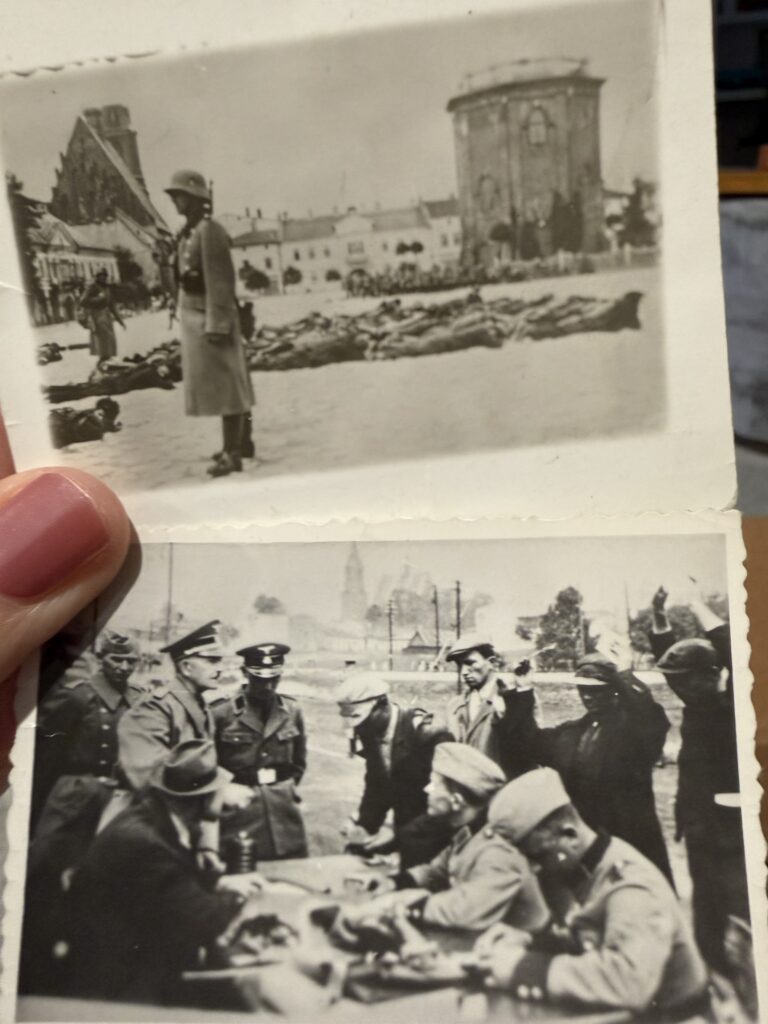
Photographs of Olkusz, Poland July 31, 1940
I turned to my grandmother, puzzled and curious, but she looked back at me passively. Her mind wasn’t what it had once been, and I didn’t want to stir painful memories. She allowed me to keep the photographs, and when I took them home, they sat on my desk as a reminder of an unknown tragedy. Every day, I studied them with a burgeoning desire to learn more about what had happened. I knew I had to write about this moment, this history.
So I dove into my research. It didn’t take long to discover that the images shown in the photographs were also available online. I had mistakenly believed these photographs were unique, the only copies in existence. But when I searched for “Olkusz and the Holocaust,” I found the same event depicted from multiple angles. The town square. The water tower rising in the background. The Nazi soldiers. The registration table. The men lying face down in the street. I even discovered a reproduction of the exact photograph I held in my hand on the Yad Vashem website.
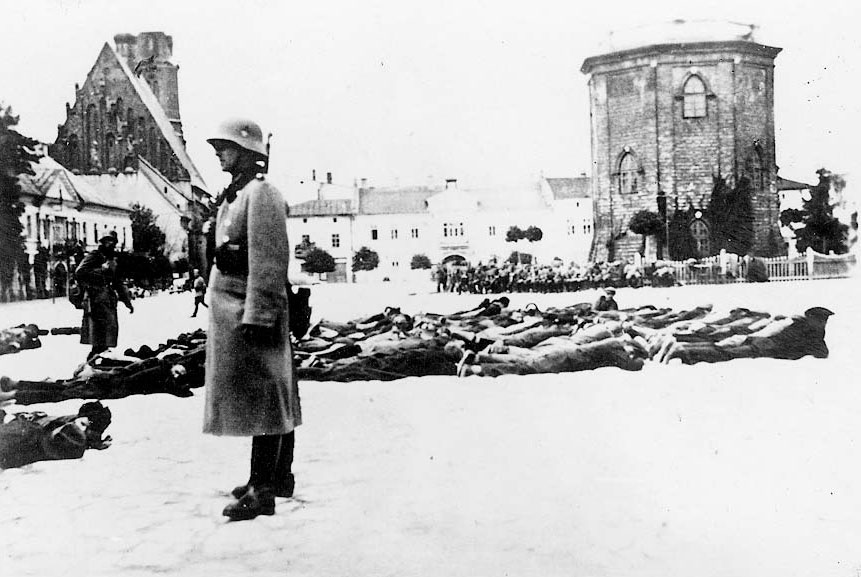
And that’s when I first learned about Bloody Wednesday.
According to Wikipedia, “The Bloody Wednesday of Olkusz … was a violent reprisal against Polish civilians perpetrated by the German occupiers in Olkusz on July 31, 1940, during World War II.” The Germans carried out their punishment as retribution for the death of a German policeman who had been killed on July 14 of that same year. In the early hours of morning, men aged 14 and older were taken from their homes and forced to lie in the square for hours on end, subjected to unimaginable abuse and humiliation.
I was surprised to learn that the Germans had photographed the incident for themselves. Their intention was to document their actions for propaganda. That’s why, nearly eighty-six years later, those images still exist. The photographs reveal the brutality and the lengths the Nazis went to in order to dehumanize the citizens of Olkusz, Jews and non-Jews alike. The photographs left a lasting impression on me. I studied the images of the men, wondering who among them were my relatives. In fact, the first chapter I wrote for my novel What She Lost was a scene that took place on Bloody Wednesday.
With the publication of What She Lost, I’ve made connections I never imagined possible.
In 2020, shortly after the book was published, I was contacted by Polish historians Michal Ostrowski and Krzysztof Kocjan, who were working to preserve the memory of the Jewish community of Olkusz before the war. We exchanged multiple emails, and I was even invited to attend the city’s 80th anniversary commemorating the Jews of Olkusz, a ceremony the town continues to observe. Because of COVID, that trip never came to pass, but attending has remained on my bucket list. I have stayed in contact with both Michał and Krzysztof: Michał created a website devoted to the Jews of Olkusz, and Krzysztof went on to publish an entire book about the town’s Jewish residents.



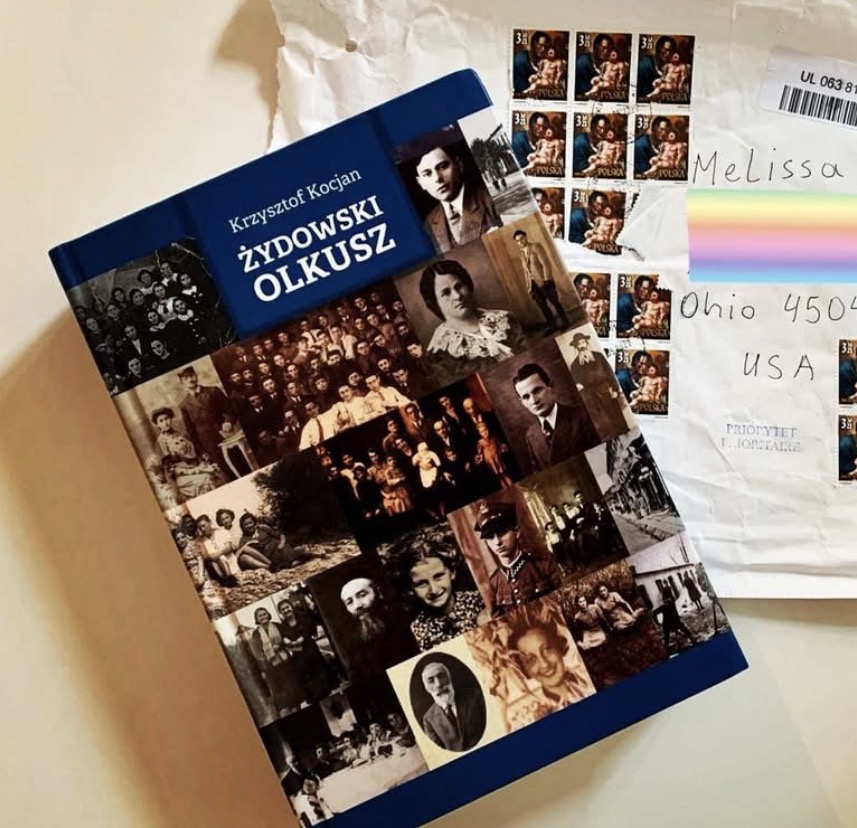
Olkusz memorial book by Krzysztof Kocjan
A few years later, I received an email from an American woman who, while going through her grandfather’s belongings after his passing, discovered letters he had exchanged with a survivor from Olkusz named Sam Waldman – my great-uncle.
“Our families used to be neighbors in Olkusz,” she wrote. Her grandfather and my great-uncle had been close friends. They had lived on the same street. We agreed to a phone call to “compare notes” and share our memories of our grandparents. When we talked, it was like we had always known each other. We quickly became pen pals and formed a friendship of our own.
Something remarkable happened through that connection. Families who had known each other in a different time and place were once more reunited. Together, we discovered a bond that transcended time, distance, and generations.
On June 14th of this year, Michal and Krzysztof, along with an American rabbi named Haim Beliak, organized a virtual reunion of the descendants of Olkusz survivors. The invitation was distributed by the Friends of Jewish Renewal in Poland. The date of this conference was significant because it fell on the anniversary of the final liquidation of Jews from the Olkusz ghetto to Auschwitz. The website for Olkusz Jews states: In June, we turn our memory to the tragic events in 1942, when Germans deported Jews from Olkusz to the Auschwitz-Birkenau death camp, where they were murdered in gas chambers. During the Second World War Nazis murdered more than three thousand Jewish inhabitants of Olkusz.
In my kitchen in Ohio, I connected with other individuals from around the globe. The invitation went out to descendants from other states as well as Canada, Europe, South America, Australia, and Israel. This is the Jewish Diaspora. The grandson of one of the survivors gave a presentation on another famous photograph taken on Bloody Wednesday called The Barefoot Rabbi. We learned that a Polish filmmaker had made a documentary about the Jewish community of Olkusz.
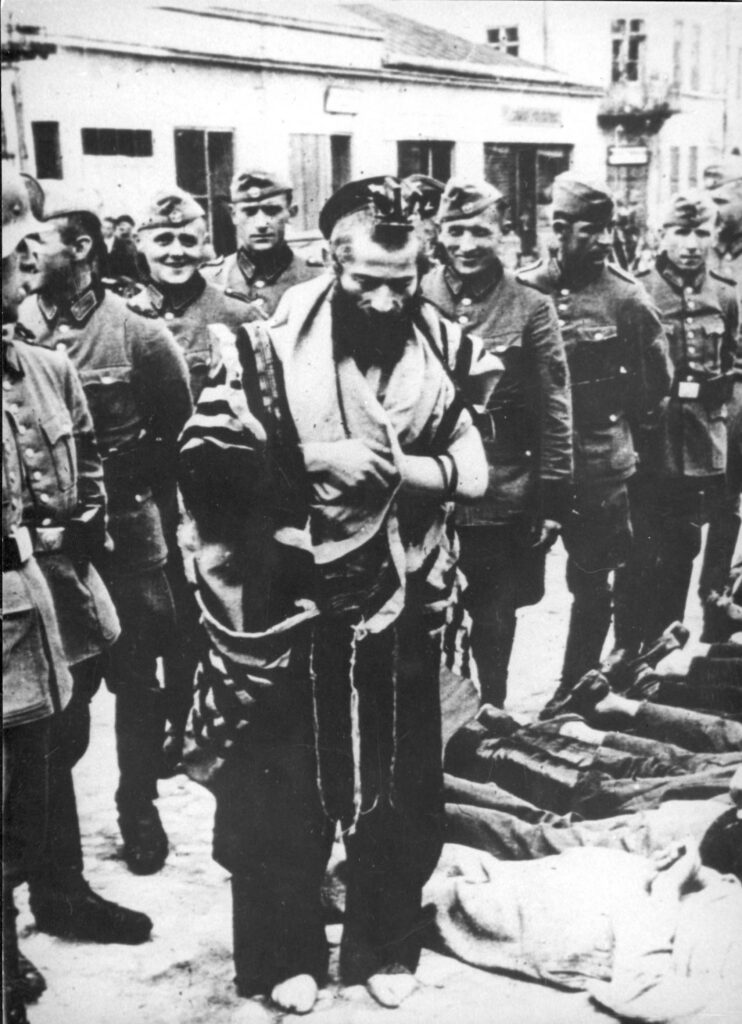
German policemen humiliating Rabbi Moshe Yitzhak Hagermann on “Bloody Wednesday” in Olkusz, Poland 31/07/1940 Image credit: Yad Vashem website
This conference had a profound impact on me. It motivated me to once again plan my trip to Olkusz, to walk in my grandmother’s footsteps and see for myself the town my family once called home. When my grandmother placed those photographs in my hands, I don’t think either of us could have imagined where this small act would lead. They became more than images of a tragedy. They became the starting point of a journey to reconnect with my roots and to remember a world the Nazis sought to erase.
Next summer, I hope to stand in the square where those photographs were taken, not simply to mourn what was lost, but to honor the lives that were lived there. While the photographs capture a single terrible moment in Olkusz’s history, the people in those images were far more than victims. They were families, neighbors, dreamers, and in some cases, survivors whose legacy continues, one generation, one story at a time.