
In 2019, I used Google to search for information on a Jewish Pittsburgh racketeer named Jacob “Jakie” Lerner. One of the first results the search engine returned was an excerpt from journalist Hank Messick’s 1967 book about Cleveland’s Jewish racketeers, “The Silent Syndicate.” The excerpt connected Lerner to Sam “Game Boy” Miller, a fixer for the Jewish mob sent to Northern Kentucky in the 1940s to make their casinos profitable.
Miller and his brothers quickly became fixtures in Cincinnati area organized crime. They were among a short-lived but significant influx of Jews to the region who came here to profit from vice.
Sam Miller was born in 1893 in Emporium, Pennsylvania, a small town where leather tanning and lumbering drove the local economy. His parents, Joe and Anna, had arrived in Pennsylvania from Lithuania shortly before Sam’s birth.
The Millers moved to Cleveland in the first decade of the 20th century. Census records for 1910 show that Joe Miller worked as a junk peddler. The family, including Sam’s three sisters — Lena, Bessie, and Annabell “Annie” — and younger brothers David, Morris “Mickey,” and Ellis “Elky” lived in a rented house.
By the mid-1920s, Sam Miller had gotten mixed up with bootleggers and gamblers. In 1925, his younger sister Annabell married bootlegger Morris “Mushy” Wexler. Sam became close to Moe Dalitz, Morris Kleinman, Louis Rothkopf, and Sam Tucker — all leaders of what Messick dubbed Cleveland’s silent syndicate. The racketeers controlled booze and gambling in the city. Their territory extended as far south as Miami, and Northern Kentucky became a main profit center.






“The inner circle of this disciplined mob, when repeal took away their source of money — bootleg whisky — went into big gambling operations,” Cleveland Public Safety Director Alvin G. Sutton in 1951 told a Senate committee convened by Sen. Estes Kefauver of Tennessee to investigate organized crime. “The Miller boys — ‘Game Boy,’ Dave and ‘Elky’ … and a new set of underlings joined in the new field of the high command.”
Sam Miller picked up the nickname “Game Boy” in these early years. Alvin Giesey, a Cleveland accountant also questioned in the Senate hearings, told interrogators that he always called him “Sam” to his face. “Other than what I read in the newspapers. I guess he is a spunky little kid,” Giesey said.
The Cincinnati Post in 1951 claimed to know the nickname’s backstory. “The story around here is that Sammy started out hustling drinks and cigarettes [sic.] for players in the casinos and come by his name of Game Boy,” reporter Joseph E. Doran wrote in 1951.
Even as late as 1973, Game Boy was making lists of memorable organized crime nicknames, along with Charles “Lucky” Luciano, Louis “Lepke” Buchalter, and Arthur “Dutch Schultz” Flegenheimer.
Cleveland Big Shot
Game Boy’s path to Northern Kentucky began as a racing wire and casino kingpin in Cleveland. Newspapers document his first gambling arrests in the mid 1920s. In 1926, police raided the Fifth City Athletic Club, where, according to the Cleveland Press, “the place is said to be run by one Sam ‘Game Boy’ Miller.”
By 1932, Game Boy was not yet 30 and already a major Cleveland racketeer and political power broker. Cleveland Press reporter Robert Larkin described Game Boy as “one of the local chiefs of the race track news monopoly.”
After a municipal election brought the replacement of the city’s public safety director, Game Boy made his move. “It was then that ‘Game Boy. felt the new shoes of a big shot comfortably on his feet, and organization of the bookie joints began,” Larkin wrote.
Game Boy ran two of Cleveland’s best-known gambling joints, the Harvard Club and the Thomas Club. Between 1932 and 1941, he racked up an impressive array of colorful arrests and convictions.
In 1935, Game Boy and his brothers David and Elky, along with three other gamblers, pleaded guilty on gambling charges. Their convictions made headlines beyond the trial when a common pleas judge ordered them to serve their 10- and 20-day terms in a jail hospital ward. The judge claimed the gamblers deserved leniency and should not have to serve their sentences among “hardened criminals.”
By the early 1940s, things were heating up in Cleveland, and the Jewish mob went looking for safer, more profitable territory. They found it in Northern Kentucky. Miller and his partners in crime Dalitz, Rothkopf, Tucker, and Kleinman, began muscling in on Newport and Covington area bars, casinos, and brothels.
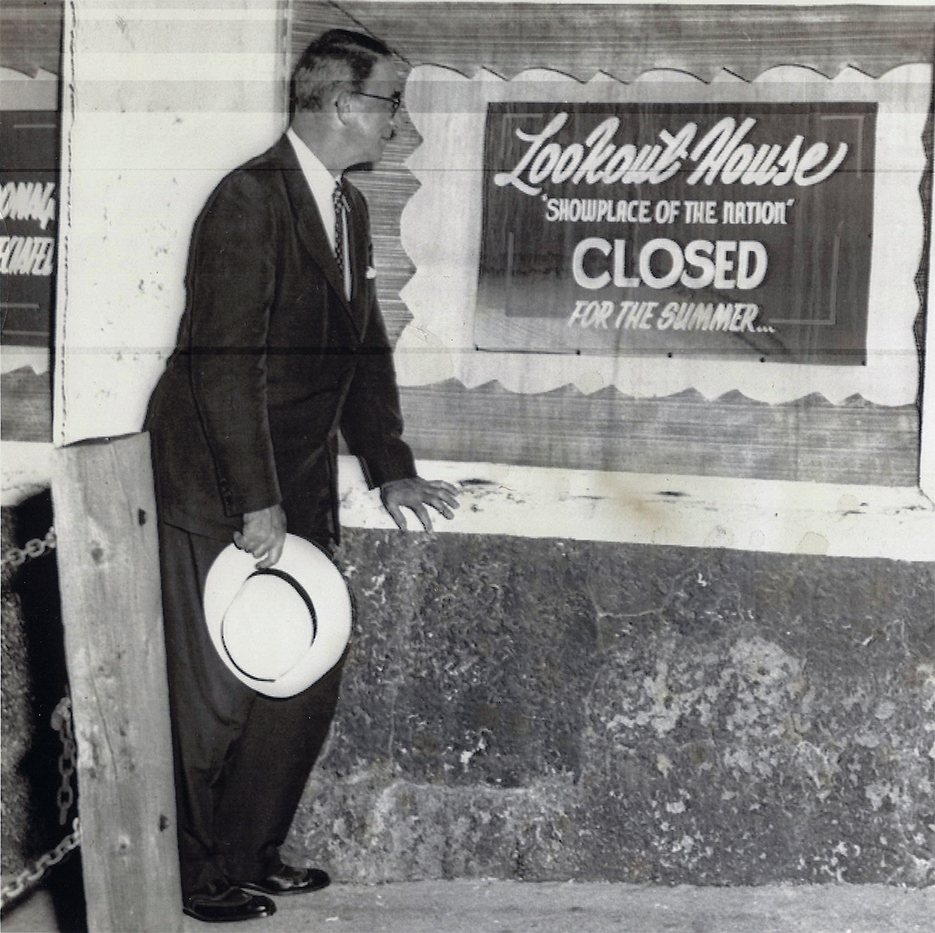
Estes Kefauver visited the Lookout House south of Covington and was photographed there next to a sign indicating the former casino was closed. Wire service photo/author’s collection.




Lookout House Turnaround
The Lookout House was a roadhouse located at the intersection of Kyle’s Lane and Dixie Highway, about five miles south of Covington. It started out as a tavern and droveyard for livestock dealers and farmers driving animals to markets in Covington and Cincinnati. During Prohibition, which lasted from 1920 to 1933, it became one of the Cincinnati region’s most popular speakeasies and casinos.
Gambler James Brink acquired the Lookout House in 1933, and in 1941, he turned it over to the Cleveland Jewish syndicate while retaining a stake in the business. The syndicate brought in a bookkeeper and then sent for Game Boy.
“They wasn’t doing much business there, and I was pretty well known, they sent for me,” Game Boy told the Kefauver Committee in 1951. When asked about his bosses in Cleveland, Game Boy replied, “I will have to refuse to answer that question for fear it may incriminate me.”
Game Boy did not appear in the hearings without putting up a fight. He was one of 17 racketeers the Senate held in contempt for ignoring subpoenas.
Game Boy was more forthcoming answering questions about his work background. “Have you earned your living exclusively in the gambling business?” committee lawyer Joseph Nellis asked him.
“That is right,” Game Boy replied.
The national attention focused on the Lookout House forced Kenton County officials to act, including enforcing a 1936 permanent injunction against gambling there. The establishment closed, and a sign appeared telling visitors it was temporary. Three years later, it was still closed when Kefauver visited and had his picture taken there.
David and Alex Miller also came to Northern Kentucky and worked as the Lookout House’s co-managers. David stayed in Northern Kentucky, where he and his wife raised a family while living in Fort Thomas, where he died in 1957. Alex left for Florida and Cleveland, where he died in 1956.
Beach Bound
Game Boy began spending lots of time in Florida. At first, he rented a Miami Beach house. By 1941, Florida and Ohio newspapers were reporting on his arrests for running Miami gambling clubs. While overhauling the Lookout House, Game Boy had been running the Empire News Service with brother-in-law Mushy Wexler since his days in Cleveland.
When Pittsburgh’s Lerner bought a Tucson ranch in 1943, it helped to make the Arizona city a key node in the Cleveland syndicate’s operations. In The Silent Syndicate, Messick wrote that Game Boy put Lerner in charge of the city’s racing wires.
The FBI quickly noticed Lerner and his ranch. “Since he located at Tucson, Arizona several of the racketeers in Pittsburgh have been going to Tucson to visit Lerner instead of going to Hot Springs, Arkansas, for the vacation as they did in former years,” the FBI wrote in a 1947 report.
Game Boy and his brothers disappeared from headlines and court dockets after the Kefauver hearings. In the Miami Beach home they bought in the 1940s, Game Boy and his wife, Sarah — her friends called her Sally — raised their daughter Gladys, a talented ice skater who made headlines of her own as a performer.
Game Boy died March 3, 1958. He was 65. An obituary published in the Cleveland Press described him as “a prominent figure in the gambling rackets.” Game Boy’s body was returned to Cleveland.