
Aaron Meyerowitz didn’t spend a lot of time in Northern Kentucky, but his brief stay there in the 1940s became part of organized crime lore in Cincinnati and beyond. Meyerowitz was a Jewish immigrant who worked for Jewish racketeers and mob bosses.
Meyerowitz came to Greater Cincinnati to work in Newport casinos operated by Jews from Cleveland and Detroit who had close ties to New York families. Those ties, and a couple of poorly conceived decisions, led to Meyerowitz being taken for a ride and killed 290 miles away in Pittsburgh, Pennsylvania.
For several decades in the mid-20th century, Northern Kentucky was a hotbed of Jewish organized crime activity. Jewish racketeers from outside the region had muscled into an established underworld vice culture. They employed locals in their casinos, nightclubs, and brothels, and attracted people, like Meyerowitz, looking for a piece of the action.
Meyerowitz’s route to being taken for the ride that ended his life at age 32 began in Kansas City, Missouri.
He was born in Poland and grew up in a modest one-and-a-half-story cottage owned by his father, baker Isadore Meyerowitz. Isadore had emigrated from Poland in 1913; his wife, Zyski, and the couple’s two oldest children, Aaron and Anna, arrived in 1920. By 1921, they all were living in Kansas City, where Isadore owned the Chicago Bakery.







Aaron Meyerowitz lived a comfortable middle-class life. Kansas City newspapers chronicled some of his childhood, from the summer days he spent swimming at a local park at age nine to the time he injured himself at age 13 preparing for a Boy Scouts summer camp.
By the time he reached his twenties, Meyerowitz had turned to stealing and stripping cars. He began using the name Danny Meyerowitz in 1934.
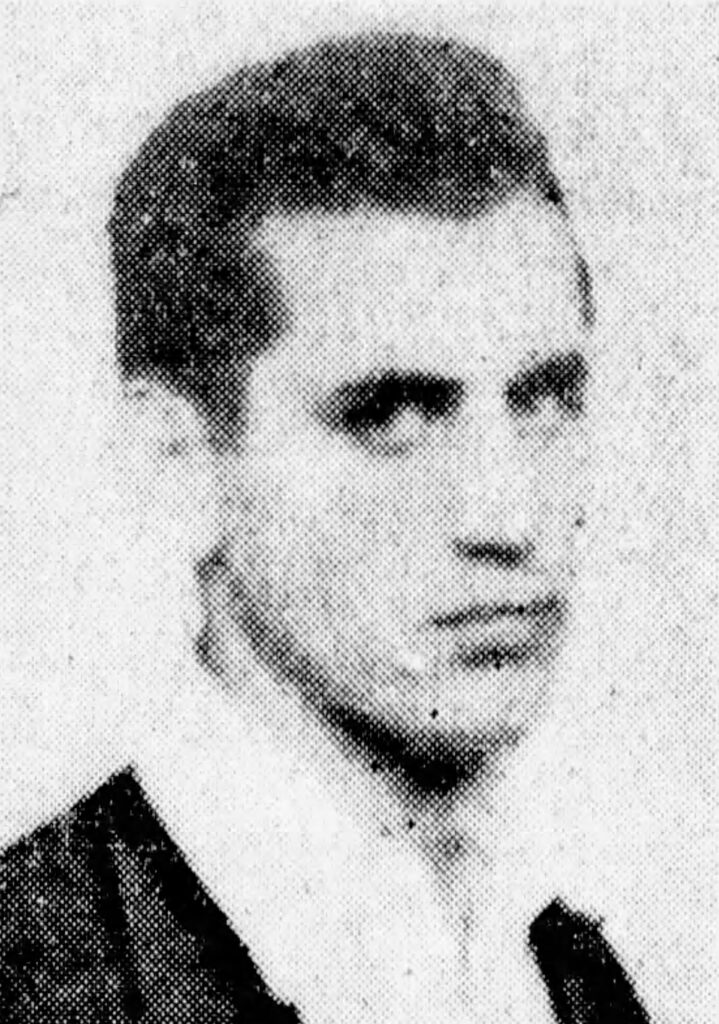
Aaron Meyerowitz photo published in The Kentucky Post, Feb. 23, 1946. The Kentucky Post via newspapers.com.
After being convicted on car theft charges and serving prison time, he was caught breaking into a safe owned by a Kansas City car dealership in 1936. “The prisoner gave his name as Danny Myerewitz,” the “Kansas City Times” reported. “He is also known to police as Danny Myers and Aaron Myerowitz.”
Aaron Meyerowitz became estranged from his family, disappearing for long periods of time and rarely calling or writing, according to statements to police by his younger brother, Sam. A brief marriage to a woman named June ended in divorce in 1942.
Meyerowitz resurfaced in Newport in late 1945 as Danny Myers. He had arrived with a record of more than 30 arrests and was working as a “stick man in a gambling house,” according to police reports.
There’s not enough surviving evidence to know which type of stickman he was or where: the kind who helped collect money at gaming tables or the kind who worked with women called B-girls inside casinos and bars to rob men. Newport had both.
The Yorkshire Club at 518 York St. was one of Newport’s best-known casinos. Owned by the Cleveland syndicate — four Jews: Moe Dalitz, Morris Kleinman, Louis Rothkopf, and Sam Tucker — New York Jews Joe and Martin Berman operated the Yorkshire Club.
Rip Farley and his brother Taylor were two of many local men and women working for the Levinson brothers, Louis “Sleepout Louie” and Ed, who owned the 633 Club at 633 York St.
The Levinsons and Bermans were close associates of New York mobster Meyer Lansky, one of the most infamous Jewish racketeers in American history. A complicated web of mob ties connected the Yorkshire Club and the 633 Club.
On Feb. 18, Rip Farley robbed the Yorkshire Club of $2,500. Perhaps not realizing (or caring) that the same national crime syndicate backed both casinos, the Farleys became instant targets for payback.





Meyerowitz blasted his way into history Feb. 22, 1946. He was one of two triggermen who delivered the payback for the Yorkshire Club robbery.
Four days after the robbery, in the early morning hours of Feb. 22, Meyerowitz and a partner in a moving car shot at the Farleys and another man, Floyd Bowman, standing outside of the 633 Club. Rip Farley died in the shooting; Taylor Farley and Bowman survived and the surviving Farley swiftly identified Meyerowitz and a national manhunt began.
The shooting quickly made headlines locally and nationally. Local newspapers dubbed it “The Washington Birthday killing. It brought too much attention to the Newport racketeers and their bosses back in Cleveland and New York.
To keep Meyerowitz from talking, historians speculate that the national crime syndicate ordered his murder. It didn’t take long for a syndicate shooter to catch up with Meyerowitz in Pittsburgh. There, police believe, the shooter took Meyerowitz for “a ride” to a secluded spot in the city’s Highland Park.
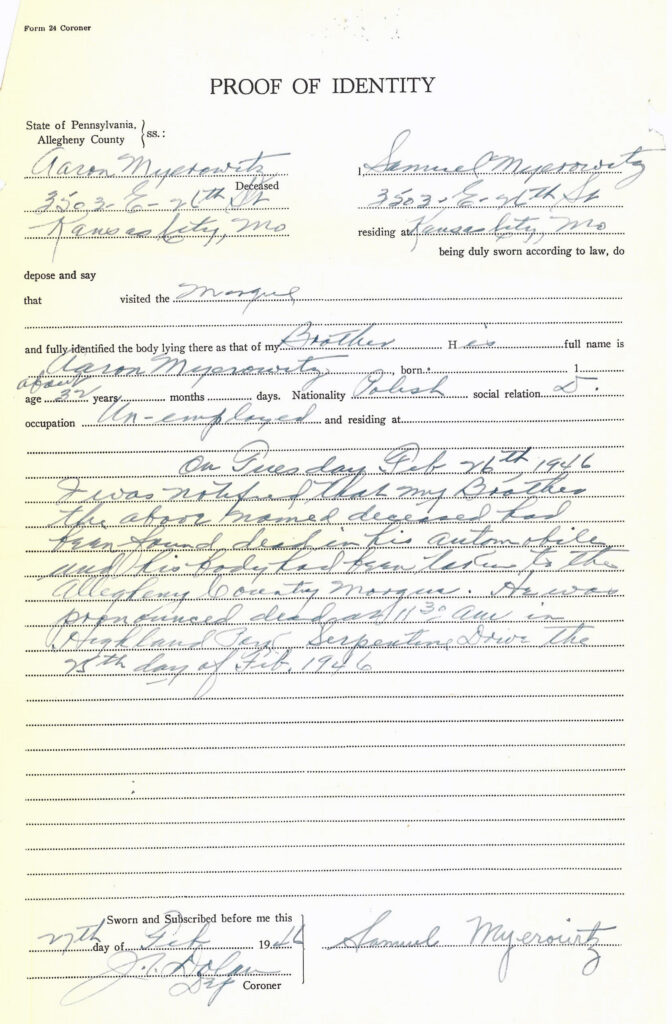
The Allegheny County, Pennsylvania, coroner’s file on the Meyerowitz murder. Image courtesy of the University of Pittsburgh Libraries and Archives.
“The victim apparently was shot to death … as he sat beside the driver in the front of the auto,” the “Pittsburgh Post-Gazette” reported in 1946. “His assailants sent two bullets from a .38 caliber pistol into the back of his head as he sat smoking a cigarette.”
A coroner’s report noted that Meyerowitz was wearing expensive clothes. Sam Meyerowitz traveled to Pittsburgh to identify his older brother’s body and answer police questions. “He was reluctant when questioned relative to his brother’s activities,” wrote Pittsburgh police homicide detective Peter A. Connors in a report filed after Meyerowitz’s murder.
Pittsburgh cops filled in the blanks about the killing the best they could from the interviews, evidence from the scene, and information from Kansas City and Newport law enforcement agencies.
“[Meyerowitz] was regarded by the police of Newport, Kentucky, and Cincinnati [sic.] as being a small town punk and gambler,” Pittsburgh’s detective Connors reported.
Meyerowitz’s murder remains unsolved, and there are few people who were alive in 1946 around today. One person who does remember the shooting and its aftermath is former Covington City Engineer Terry Hughes. He grew up in Newport, in a tenement near the 633 Club.
“I remember as a kid walking up and putting my fingers in the shotgun place [in the wall], blew it out,” Hughes recalled in a 2025 interview. The shooting was a major, albeit grim, milestone in the neighborhood and city’s history.
The Yorkshire Club building survives, but the brick wall of the 633 Club is long gone, along with the casino where Meyerowitz sealed his violent fate and where a key chapter in Cincinnati’s Jewish organized crime history was written.