
In the year following Oct. 7, more than 10,000 antisemitic incidents were reported across the United States, prompting some local Jewish residents to seek empowerment at Cincinnati Krav Maga, the city’s only studio dedicated to the Israeli self-defense system.
Aaron Binik-Thomas brought the mixed martial art to Blue Ash 13 years ago.
He says Krav Maga is designed to meet people where they are, emphasizing techniques that work with natural movements rather than against them.
“Krav Maga is continuously evolving,” said Binik-Thomas. “It’s not a strict, rigid, ancient martial art, like other martial arts are. It’s designed to work smoothly with wherever you are in your life, whatever condition you’re in, whatever shape you’re in, however speedy you are.”
To Binik-Thomas, one of the distinguishing features of Krav Maga is its emphasis on situational awareness, practical responses to real-world threats, and defense techniques that constantly evolve to adapt to modern threats and scenarios.








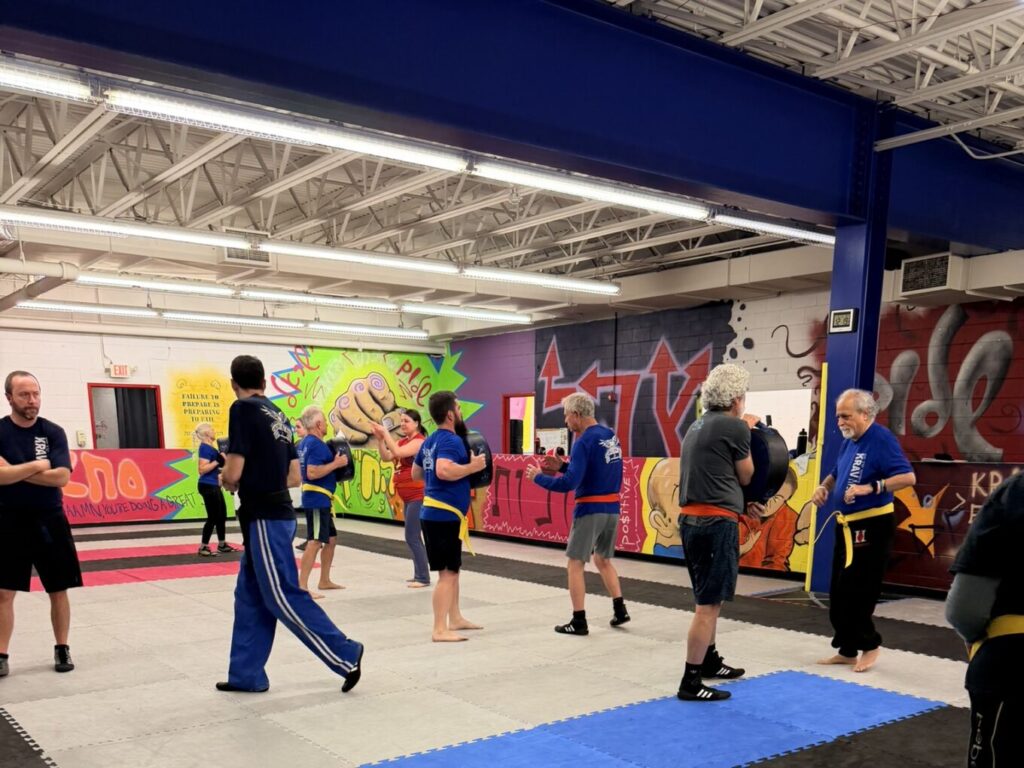
Students doing drills at Cincinnati Krav Maga (courtesy)
“You’re coming home, you’re leaving the grocery store, you’re in a parking garage,” he said. How do you defend yourself in those different situations? How do you de-escalate that before it turns into something real? And if it turns into something real, how do you stop it and finish it and make sure it doesn’t turn into something catastrophic?”
He says that as technology evolves and our surroundings change, so do the ways we defend ourselves.
“We learn how to use your cell phone as a self-defense technique,” he said.” You didn’t have cell phones in 1970, or the 80’s, so that’s a recent adaptation.”
Much of Krav Maga focuses on mastering natural techniques and applying them in ways that allow students to quickly evade danger in real-world situations.
To enhance training opportunities, Binik-Thomas brings in certified Krav Maga instructors from across the country and around the world. One recent guest instructor was a former Israeli Defense Forces special forces officer.
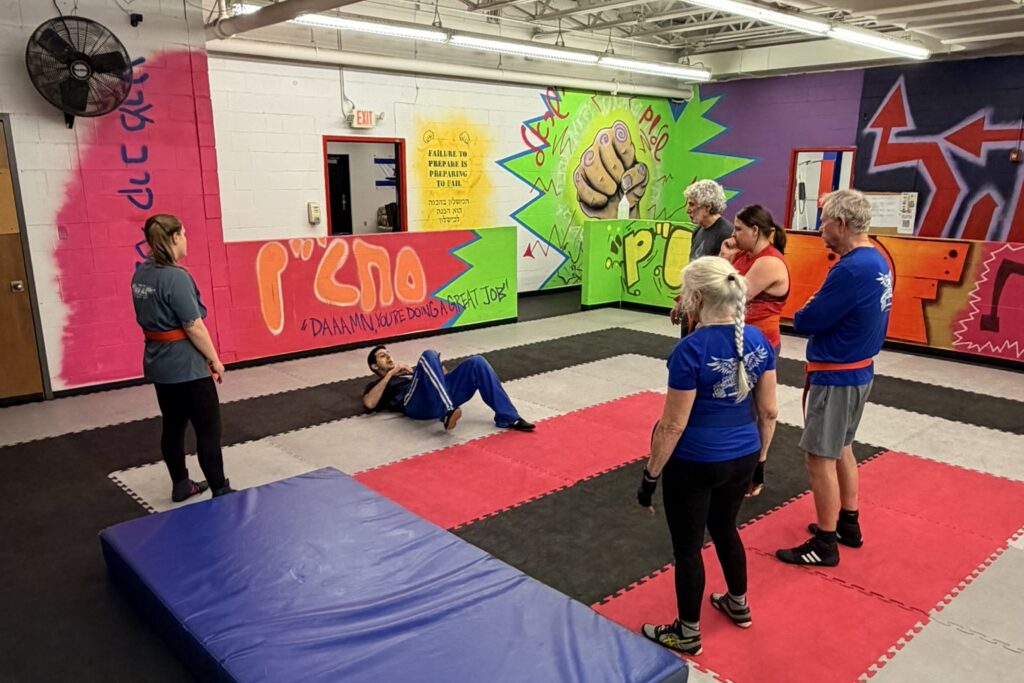
Students receiving special instruction. (courtesy)
He says the studio aims to foster a strong community and encourages self-defense training for everyone.
“We’re open for everybody. In Judaism, we have spread so much amazing stuff to the world, and self-defense should be no different. We’ve got one of the greatest, if not the greatest, self-defense systems in the world. That’s something I think everybody should be able to participate and join in. It’s founded by us, created by us. It’s based on our historical struggle to stay alive and protected,” said Binik-Thomas.
Friend and studio member Nina Perlove began classes last summer. She says she was motivated by a desire for exercise and self-defense, especially as a woman in the Jewish community amidst rising antisemitism.
“Being Jewish in today’s world, we feel a lot more vulnerable, and we feel like attacks are coming at us from many directions, whether they’re conversational attacks or political attacks or or potentially even physical attacks,” she said. “So it made a lot of sense for me to add this to my life and my routine.”




She says she appreciates the community aspect of the studio, noting the diverse participation across age and gender.
Perlove says she found meaning in the importance of trust in partner drills and the mental and physical confidence gained from the training.
The classes, while not exclusively Jewish, share a common connection through Israeli self-defense principles, fostering a sense of safety and camaraderie.
“It’s empowering. I definitely feel like a different person. I feel confident when I’m out and about. I feel like I have a better sense of what I’m capable of doing if I were to need to defend myself,” Perlove said.
She says the training can help level the playing field for people of smaller stature, a significant benefit for many Krav Maga students.
“Krav teaches you very specific techniques, so that in various different scenarios, you’re trained to know where you can maximize your strength and maximize the weakness of the person who might be doing you harm.”
Perlove says having the confidence to keep herself safe is her way of fighting fear and holding her head high as she ushers in 2026.
“There have been a lot of attacks on Jews lately, and there is a mentality, I don’t want to be a victim, and that’s sort of the mentality of Krav Maga. The first mentality is you decide that you are not going to just be a victim. You’re going to use what abilities you have to fight back and give yourself a chance to get away or survive.”
Binik-Thomas says that while he hopes for a safer 2026 for Jews across the diaspora, in the meantime, he’ll continue sharing Krav Maga’s safety tools and, hopefully, inspire new connections in the Cincinnati Jewish community.
“You walk out after class, and they’re [the students] hanging out in the parking lot together, just laughing it off for an hour or two,” said Binik-Thmoas. “It’s amazing. That’s what we want to keep together.”