
After nearly six months, the exhibition “Auschwitz. Not long ago. Not far away” is preparing to close its run at the Cincinnati Museum Center at Union Terminal. During that time, visitors have walked past more than 500 original artifacts from the Auschwitz-Birkenau State Museum in Poland, including shoes, suitcases, toys, prisoner uniforms, and even fragments of barracks, each object silently testifying to lives disrupted or destroyed. I was fortunate to visit the exhibit as part of the Descendants’ Program with the Nancy and David Wolf Holocaust and Humanity Center (HHC) to bear witness to a history very close to my heart. The showcase, on display until April 12, 2026, confronts visitors with both the brutality of the Holocaust and the resilience of those who survived.
That act of witnessing lies at the heart of UNBREAKABLE: The Remarkable True Story of a Holocaust Survivor’s Six-Year Journey from Nazi Labor Camps to Buchenwald by author Edmund A. Kruszynski.
I met Kruszynski when we both participated on the HHC’s “We Will Remember” panel to discuss crafting family narratives and navigating the publishing process. I spoke about writing my debut novel, What She Lost, while he spoke about his novel, The Medic’s Wife. We connected over a love of prose and history, and remained in touch after the evening’s close. When Kruszynski shared the details of his latest novel with me, I was eager to dive in.
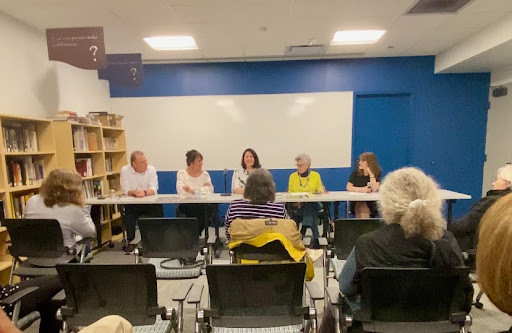
We Will Remember author panel at the Nancy and David Wolf Holocaust and Humanity Center (Kruszynski on far left, Hunter in the middle) Image credit: Melissa W. Hunter
UNBREAKABLE tells the true story of Rafal Kantor, a Polish teenager whose world was shattered when World War II engulfed Europe. Like his earlier bestseller The Medic’s Wife, Kruszynski once again turns to history not as a distant fact, but as lived experience, told through the eyes of someone who endured the unthinkable and survived. As I read this beautifully written book, I found so many parallels between Rafal’s experiences and my family’s own story. The loss of innocence in the face of unimaginable horror, families torn apart by war, surviving inhumane conditions, and the courageous act of living again, of finding meaning in life, after experiencing such devastation. This was the narrative I tried to include in my own novel, believing that through stories like these, the memories of what a generation of survivors experienced won’t be forgotten.
Holocaust memoirs often confront readers with overwhelming darkness, but UNBREAKABLE is equally concerned with endurance. Rafal survives a six-year journey through ghettos, deportations, labor camps, and ultimately the concentration camp Buchenwald, not because conditions become easier, but because he refuses to surrender his humanity.








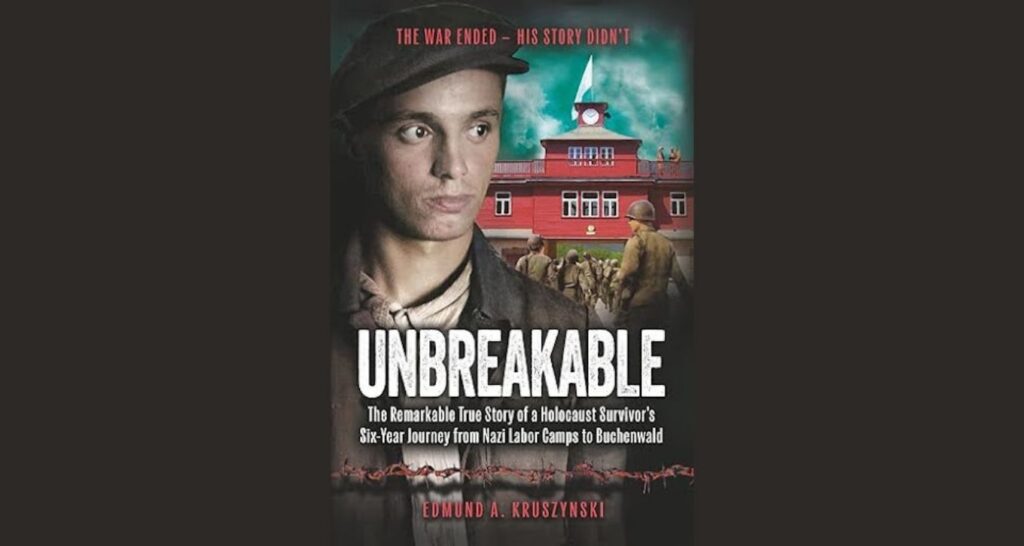
Unbreakable book cover
What makes UNBREAKABLE especially remarkable is how that story came to be told.
On April 17, 1945, Rafal Kantor lay barely alive in the camp hospital at Buchenwald, clinging to life as Allied forces closed in. That very same day, just beyond the camp gates, U.S. Army combat medic Staff Sergeant Edmund Kruszynski (the author’s father) arrived with the liberating forces and witnessed firsthand the devastation left behind. For decades, neither family knew this shared moment in history existed. Nearly eighty years later, by chance, Kruszynski met Rafal’s son, Ron Kantor, in a Cincinnati café. What began as a casual conversation led to a startling realization: their fathers had been in the same place, on the same day, at one of history’s darkest crossroads . . . one as a prisoner fighting to survive, the other as a medic bearing witness.
“That was the moment everything changed,” Kruszynski says. “It stopped being coincidence and suddenly became responsibility.”
That chance meeting sparked a two-year collaboration between the two sons, built on trust, shared history, and a commitment to ensure Rafal’s voice would finally be heard. Drawing from Rafal’s handwritten testimony, recorded interviews, and decades of reflection, UNBREAKABLE is told largely in Rafal’s own words, bringing readers inside moments history books often overlook.
Kruszynski writes in a style that blends historical research with accessible storytelling. While the narrative reads like a novel, it remains rooted in the lived experience of a survivor. Yet the book also raises an essential question: what happens to these stories once the generation of survivors is gone?
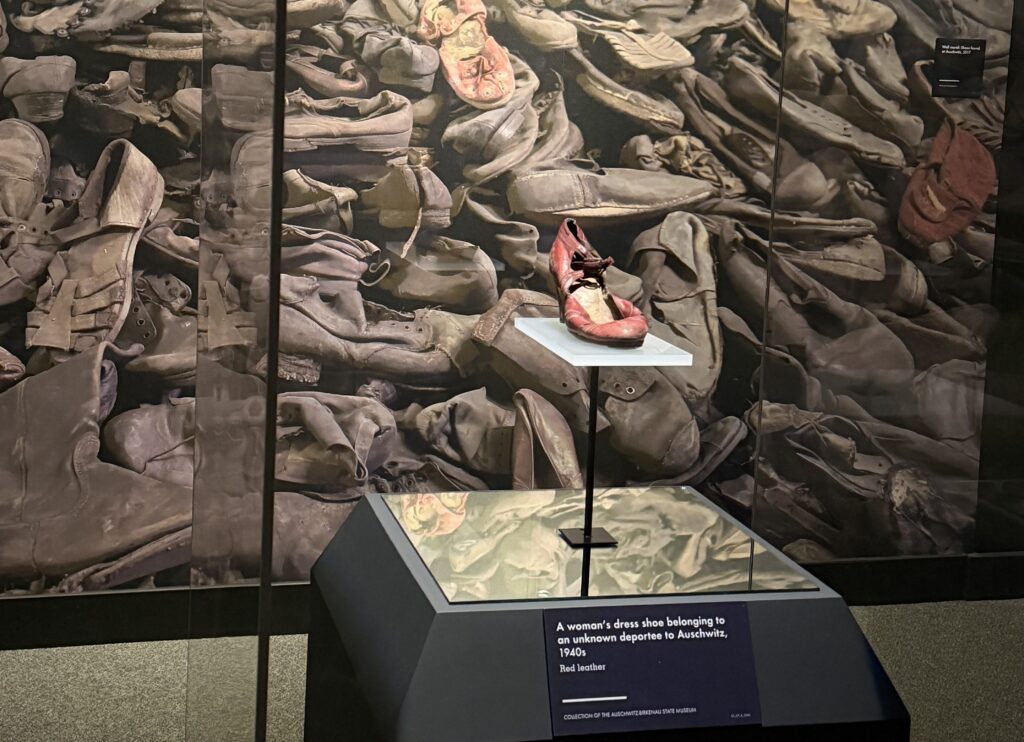
Like the exhibit “Auschwitz. Not long ago. Not far away,” Holocaust literature plays a crucial role in carrying memory forward. Each survivor story preserved in print becomes another safeguard against forgetting. Every retelling ensures that the voices of those who endured the camps will continue to be heard long after the eyewitnesses are gone. The exhibition deliberately emphasizes the individual lives of survivors, victims, and families to remind audiences that the Holocaust was not an abstraction but a catastrophe experienced by millions of people with names, histories, and loved ones. In that sense, books like Unbreakable and What She Lost serve the same purpose as the exhibition itself. Both transform statistics into stories. Both insist that behind every number was a human being. Both remind us that while exhibits may close, the work of remembrance continues . . . page by page, story by story, generation by generation.