
Who the Folk?! Cincinnati is Cincy Jewfolk’s new podcast spotlighting the diverse voices shaping Jewish life in the Queen City.
Hosted by Cincy Jewfolk’s editor Sam Fisher, the series features conversations with notable and fascinating Cincinnati Jews—from artists and entrepreneurs to community leaders and culture-shapers.
Each episode dives into personal stories, passions, and perspectives, showing that Jewish life here is anything but one-size-fits-all.The Who the Folk?! Cincinnati podcast is part of the Jewfolk Podcast Network and a product of Jewfolk, Inc.
If you have suggestions for Who the Folk?! Cincinnati podcast guests, please fill out this form.
Be sure to check out the entire series and follow along as Sam interviews and features notable Cincy Jews & Jews doing interesting things in the Queen City!








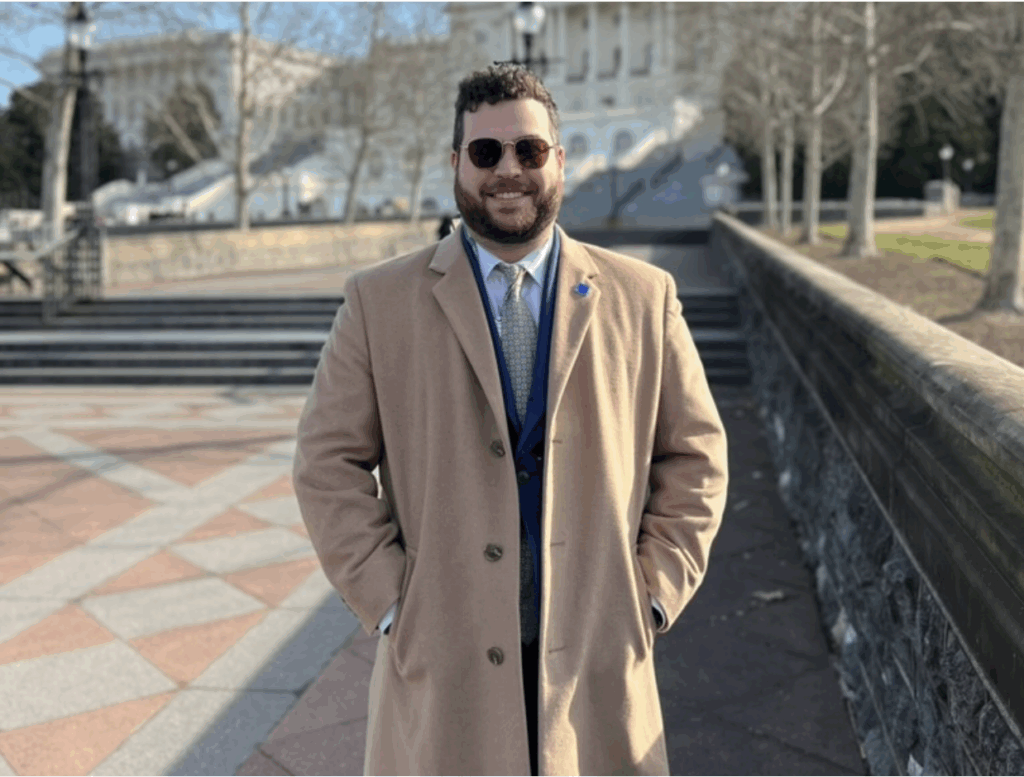
Introducing this week’s WTF?! Cincinnati’s guest
Rabbi Zachary S. Goodman was born and raised in Dallas, Texas and attended the University of Texas at Austin before he was ordained on the Cincinnati campus of HUC-JIR.
Following his ordination in 2019, Rabbi Goodman served as the Assistant Rabbi at Holy Blossom Temple in Toronto before joining the Wise Temple family in the summer of 2022.
Rabbi Goodman is passionate about Israel education, youth and teen engagement, young professional programming, and learning in all its many forms.
Music is also an important part of his life; he plays guitar, piano, and sings. Rabbi Goodman loves to explore the outdoors, travel, cook, watch sports, host game nights with friends, and spend time with his two sons.
Listen to this podcast episode
A note for you
Below, you’ll find a full transcript of this interview. We provide these so that you can read along, catch anything you might have missed, or revisit your favorite moments.
We do our best to make sure everything’s accurate, but if you spot a typo or mistake, that’s on us. We hope you’ll enjoy listening — and reading — along!
Show transcript
Sam: Zach, thanks so much for being a guest on the show. The first question I have for everybody, just because of my family background, are we related?
Zach: I don’t think so.
Sam: Okay, good, good.





Zach: Do you know any Jews in Texas?
Sam: You and Rabbi Smolkin and that’s the only Jews I know that came out of Texas.
Zach: Great. You’ll have to meet Rabbi Hirsch.
Sam: I don’t know what it is we’re attracting all these Texas Jews in Cincinnati. Well, that leads us very naturally into my first question, where are you from? Where’d you grow up?
Zach: Great, yeah, I grew up in Dallas and went to school in Austin, and belonged to a nice reform congregation in Dallas, still home.
Sam: Still. And did you do any of the traditional Jewish kid growing up in the suburbs kind of things? Did you go to Jewish summer camp? Did you, were you involved in youth group?
Zach: Yeah, I went to Jewish summer camp. And I went to Camp Sabra in the Lake of the Ozarks, Missouri, and I was really quite involved in BBYO growing up. The local level and the regional level, and then some international programming as well.
Sam: And when you were a kid, kind of growing up outside of Dallas was … you know, obviously being a Jew was important to you. You were involved in these, BBYO. You were going to Jewish summer camp. Was sort of the pull into, like, the more spiritual rabbinical part of Judaism, was that always something that had a pull on you? Or did that develop as you grew up?
Zach: Oh, it’s so interesting. I love that question. I don’t think it was something, it depends on what you think of like when I was a kid. So I knew I wanted to be a rabbi my senior year of high school. I went on the March of the Living with BBYO, and that’s when I realized that I wanted to become a rabbi. But the spiritual pool, I don’t really know. I think that when I told people that I wanted to be a rabbi. They were like, Oh, yeah, that makes sense. But it was also like, totally out of nowhere. Like, there’s no rabbis in my family. There’s no I mean, we were, I like to use the term we were, Submarine Jews. Have you heard the term Submarine Jews?
Sam: Please, please.
Zach: Sure. So I like to think we were. We had a really like beneath the surface, very strong Jewish identity, love of Israel. All of those things were really instilled in my family life. But when it came to like, going to temple, we really just emerged, you know, every, couple times a year.
Sam: A couple times of year. For High Holidays.
Zach: Exactly. For a special Shabbat or something. But, yeah, it wasn’t, it wasn’t like an organizing factor in our life, necessarily. But the identity was always very much there.
Sam: Which I guess is very common. I think it’s super, very common today among most Jews, especially Jews our age. We’re both millennials.
Zach: Sure.
Sam: I think growing up, even for me here, I’m sure for a lot of kids down in Texas. So when you said people said, “That totally makes sense, but it also came out of nowhere.” When those people were saying that makes sense, what do you think they were judging that on? Was it just your involvement in youth group, or is it just there was something that you didn’t see in yourself until then?
Zach: I think it’s more of the latter and and the former. I when I was in the youth group, I always was interested in leadership positions, but I gravitated towards the Jewish content. So like on my on a local level, I wanted to be like the chapter president, but on a regional level, I wanted to be, you know, in charge of the Jewish programming, and trying to find a way to say it while staying humble, which, which is … When I said, “Oh yeah, I’m thinking about becoming a rabbi.” And, “we can see that for you.” I think it was more about I always had a way of connecting with people, or being able to have a mature conversation with older folks. And so there’s like a disposition, I suppose that they saw in me when I was young, and I didn’t really see it in myself, and it was like, Oh yeah, okay, we can that makes sense. Like that seems fitting.
Sam: Where do you think that came from? That kind of disposition of wanting to talk to people?
Zach: I don’t know both. You know, everyone in my family has like, a love of people like I just think people are interesting. My dad had lots of leadership opportunities within the Jewish community, the JCC, and sitting on this board and that board, and there were bus captains on Israel trips and things like that. So I say the Submarine Jew thing, kind of tongue in cheek. We were, you know, members of a congregation. We went to Sunday school every Sunday, you know. So we had a really strong sense of Jewish identity.
Sam: Were you like the kid at home when you did, like, Shabbat at home, that you were like, We’re gonna I really want to do these things, like to the utmost, or was that something that you did?
Zach: Yeah, I don’t know. I even feel like even after I knew I was going to rabbinical school … So, well, I have an early childhood memory, actually, of being in our living room, and we had, it was back in the day when you had like, the six, six CD stereos, you know, and I would fill them up with like, Debbie Friedman and Jewish music. And, you know, take the Beatles CD out and put in the Debbie Friedman CD, and they’d be like, what, what’s going on here, you know? And so we’d be singing Osei Shalom in the living room. And so I always felt drawn to it. But it wasn’t really, until I went on the March of the Living that I saw that as like, oh, you can do this. Like, this could be a career. My dad, even, I think, was at a Yom Kippur service. I’m sitting in the service, and I’m like, really following along in the Matsur, really following along in the prayer book. And he they’re kind of, my parents are like, like, look, look at the kid. You know, he’s, he’s paying attention, you know, he’s really, he’s very into it.
Sam: You were engaged from a young age.
Zach: Yeah. And so my dad said to me, you know, you could be up there one day. And we both laughed, like, yeah, right. Like, I’m gonna be like, Rabbi David Stern at Temple Emanuel in Dallas, you know, whatever. And we both laughed. And I guess, I guess it just kind of stuck with me. You know, kids grow up and like, oh, I want to be a doctor. I want to be a lawyer. Yeah, on my list of “maybe I’ll do this” things was also rabbi.
Sam: Yeah, well. Because it doesn’t seem, if you’re not from a family that has rabbis in it, it can be very, you know, that the congregational rabbi is like, there is an aura about them when you’re a kid, because they’re the ones in charge of this. They are, like, this spiritual kind of or they hold some secrets that maybe you don’t know, especially when you’re young.
Zach: When you’re young, we really put them on this pedestal. And yeah, so I had this reverence for my rabbis growing up and but, like I said, we weren’t so involved that I really knew them. You know, my rabbis growing up were like, proud of me when I told them I was going to rabbinical school. But, but, yeah, they I wouldn’t as much as I love that Rabbi. I wouldn’t necessarily credit his, his, his beautiful leadership of our community to being what drew me in.
Sam: Yeah, of course. So that kind of leads you to college and then eventually to HUC?
Zach: Sure.
Sam: And is that how you ended up coming to Cincinnati? Or?
Zach: Yes, yeah. I came to Cincinnati for HUC. I went to the University of Texas. And I knew all the way through the University of Texas that I was going to go to, or I was hoping to go to HUC. In fact, I was a Jewish Studies major at the University of Texas, and I realized, I forgot who, someone said it to me, like, what if you don’t get into HUC? And I was like, Oh, I would be, that would be tough.
Sam: What am I gonna do?
Zach: So I ended up getting a business degree as well, just in case, in case it didn’t work out. But it did. And so I, 12 days after I graduated from college, I was on a plane to Israel. You do your first year in Jerusalem, and then the next four years in Cincinnati.
Sam: And was there a reason you chose? Because at that time, they had the three campuses were all open when you were there?
Zach: Yeah, all three campuses were an option.
Sam: What made you want to come to Cincinnati?
Zach: Oh, I want to watch my words carefully here. So each of the campuses at their height kind of had their own character, and I was interested in, who am I going to be in class with? So on the LA campus, they were running programs with the nonprofit professionals and things like that. And I understood that to be a more spiritual center. They do great pro great education on how to do pastoral care and pieces like that. In New York, you would be in classes with also nonprofit professionals, but also you would be in class with the cantors because the cantor cantorial program is in New York, and New York is also the hustle and bustle of New York. And, yeah, you know, your campus is just a, you know, in a high rise in a building right in New York. And so start with a campus. And what sold me on Cincinnati is a, it’s livability, but also who’s in the classroom. So in Cincinnati, I thought of it as the kind of the academic center learning with PhD students and people who are working on their masters. And I felt going into school that my, the pieces that I really needed to build were my were my education, and that the things that I felt like I still needed to develop, but I, I was feeling strong, was, I’m able to connect with the people, like I had interpersonal peace. What I didn’t have was the Torah. What I didn’t have was the scholarly piece. And so Cincinnati, both for its campus, feel I could, like, live here comfortably and really have that, that kind of top tier education.
Sam: And while you were here, you, you know, I read that you interned at at Rockdale.
Zach: I interned at a couple places.
Sam: But also it took you around the Midwest as well, while you were at HUC. And you know, one of the things I find interesting is that what HUC used to do, it seems like they may not be doing that anymore, is sending their rabbis to small communities who need, maybe don’t have a large enough community to have a permanent rabbi. And you know what was was it like to explore communities and parts of the country people don’t associate with having like Jews? They’re like church communities?
Zach: So I went to in my time at HUC, I had some really interesting internships in town where I got to work with wonderful rabbis like Sissy Coran. May her memory be a blessing, at Rockdale, as well as Meredith Kahan. Rabbi Kahan, who’s now the senior there. As well as I got an opportunity to work with Rabbi Barr at Beth Adam, a humanist organization, a humanist congregation. So very different fields. I never actually had the opportunity to work at wise temple, but I was a, I was a congregant at Wise Temple, and got married at … Street. And so that was really interesting. And then traveling around, I was in New Iberia, Louisiana. In Grand Forks, North Dakota. So you can imagine on a map, pretty, pretty spread out. And and both of them, like you said, I thought to myself, the first I was like, oh, like, there’s Jews here. You know, of course there’s Jews in like New Orleans and Lafayette, but New Iberia, that’s where they bottle a hot sauce.
Sam: That’s how they make Tabasco.
Zach: All Tabasco sauce is made on the Island in New Iberia. Fascinating community, wonderful community, really kind of sustained by two or three different family, large Jewish families. And it was so fun to get to meet them. And I still, not close contact, but I still kind of stay in touch with some of those families. And inGrand Forks, North Dakota, I had never been. I mean, I’m from Texas. It was so cold. And I remember going up there with the heaviest jacket I had. It’s just like a pullover, you know.
Sam: Yeah, Northface.
Zach: And it was like, exactly. And it was like September and 20 degrees, and I was like, oh this is gonna be a problem, you know. I’m gonna have to get some serious stuff. And it was, they call themselves the frozen chosen, which kind of a lot that’s used to a couple of different places. But they were also such a fascinating, such a … that was a really interesting one, because, you know, I’m trained as a Reform rabbi. But in these smaller communities, they had lots of different makeup of of different identities. So there was some Modern Orthodox and there was some Conservative, and there was, and so we had to strike a balance of, okay, we’re going to use the conservative siddur to lead a reform service and then eat kosher food at the synagogue. it was just like we had to try to make a community that made sense for everyone, where there’s really just not that many Jews. There’s not enough Jews to have more than one synagogue in Grand Forks.
Sam: In a way that’s kind of a great picture of just American Judaism, where it’s like we’re using all of these different things to try to not satisfy everyone, but to make something that’s equitable for everybody to come and join in.
Zach: Right? How does it work? How do we, how do we be in community with one another? That was a good model. It worked. It wasn’t perfect, but it totally worked. And they were lovely.
Sam: Nothing, nothing is. So you got your degree at HUC. You then left Cincinnati for a little bit.
Zach: I did.
Sam: You went up to Toronto.
Zach: The Great White North.
Sam: Yeah, so with some other Frozen Chosen. And then what brought you back? What brought you back to Cincinnati?
Zach: Sure, so some, it was really nice. So we had, when we were up there, I had two, two children in Toronto, and their grandparents live in Cincinnati, and so it was like, part of it was like, it would be really nice to be around family, but the real draw was, was Wise Temple. Yeah, I’d always, I’d always loved this place, even though I never worked here before, and I felt extremely close to Plum Street Temple. And when I saw that there was an opening here, I thought, well, you know, I gotta throw my hat in. So I actually it wasn’t really even in my game plan to be leaving Toronto. I thought I was going to be there another five years. And when I saw that this place was the placement was open here, I very quietly applied just here. I didn’t, like, you know, rabbis had, like, a placement process, and you go put in your interview, new interview all over the country. So I just reached out to Wise Temple and just said, like, I’m just applying here. Like, this is a dream job for me.
Sam: And it just worked out, when you say you felt this connection that you said you got married at Plum Street, you were ordained at Plum Street. Was there something else that you felt that connection? Was there some other thing that was that kind of that pulled you about Wise Temple?
Zach: About Wise Temple? I was also at a part in my career, still am. I’m still learning a lot, but at that point in my career, I was really interested in in collecting, that’s not the right word, but, but having great mentors. And so I had known about Rabbi Lewis Kamrass for many years, but I never really had a close relationship with him. I was working with an incredible rabbi at the time in Toronto, Rabbi Yael Splansky, and I had learned a great deal from her and and I was interested in learning two different models.. And so I would say a big draw here was not just the Plum Street temple, not just the portfolio, not just the city, but who am I going to be learning from? So Rabbi Karen Thomashow was here at the time too, and I was still have a nice relationship with her, and I was thinking she would be here for awhile as well, and get to learn from her and learn from Rabbi Kamrass. And so that was a big draw for me as well. And now that Rabbi Hirsch has arrived, it’s another, like, wonderful. We just had the conversation yesterday, of like, we repicked each other. You know, it’s as if I went through placement again and chose him as my mentor, and he chose me as his associate rabbi. And so I’m also equally excited about the future. The things that I have to learn and to offer and to still to be a mentor to younger people, but still have a great mentor in Rabbi Kamrass and Rabbi Hirsch.
Sam: That’s fantastic. And what was it like to kind of transition into becoming a full time person in Cincinnati? Because Cincinnati is, I mean, it’s a bit of a provincial town, you know, the most common question is, where’d you go?
Zach: To high school.
Sam: Yeah. And what has that transition been like for you, not only coming in, you know, professionally, but somebody who had been here before as a student and then left, you know? What has that transition been like, becoming like, more enmeshed in the community?
Zach: Yeah, I think if Cincinnati is like a big fish bowl, which is both fun and a little scary, you know, like, I gotta think about, what am I wearing to the grocery store, because I can’t look like a schlub and show up at the Blue Ash Kroger and bump into congregants and people, you know. So that’s a, that’s a kind of a funny thing that I never had to worry about in Toronto or in Dallas. And I also find I’m glad that you use the term provincial town. I sometimes, without thinking about it, call Cincinnati like it’s, it’s such a wonderful town, or it’s a sports town, or it’s, yeah, and people from here like, we’re a city, you know, don’t call me a town. We’re a city. And it’s no, no, it is. It’s very much a city, but it has this kind of like town feeling. I love the pace of life here. I love the culture, I love the history. I love the like Midwestern, I call it Midwestern Nice. It’s just, it’s a lovely place. I don’t like driving here. I’ll give you that the drivers are …
Sam: I hate to break it to you. People say that about everywhere.
Zach: Yeah, but I’ll tell you, it’s particularly bad. I’ve lived around lots of different places. But I love the city and the people and the congregations and I also love how well all the congregations play to get like, we really, we’re in a nice relationship with one another. It’s not competitive. It’s not like, Oh, we got a one up, you know? It’s like, we all, we all really kind of take care of each other and understand each other. And, yeah, it’s wonderful.
Sam: Because there is a certain feeling in Cincinnati in general, not just the Jewish community, but it’s there is this feeling of, it’s Cincinnati versus everyone else. Cincinnati versus the state of Ohio versus the rest of the country. And I think, you know, one of the great things about our community is that we do punch above our weight in many ways, and that sort of moves us on to the next, next portion of our interview. To, you know, kind of what you’re doing now, what you’re doing now here at the temple, I know right now, you’re teaching a class about Jewish storytelling. Oh, yeah, I figured we take a moment to talk about that a little bit. To you, you know, kind of, what is the difference between, you know, I’d say, like American storytelling, like Mark Twain, someone like that, and sort of more traditional Jewish storytelling. It could be, you know, we don’t have to use American storytelling as an example. But it could be.
Zach: No, I like the framing of that actually. And to answer I’m going to do a really Rabbi thing. To answer it, I’m going to tangentially ask other questions and tell other things. So it reminds me a lot about food and cooking and that there’s no such this is a jarring comment for people to hear sometimes, that there’s no such thing as Jewish food. What are you talking about? Of course, there’s Jewish food, and we can name them, right? Matzoh ball soup and … you know, and bagels and lox and borscht, whatever, you know, you can think about them. And then when you really think about that, it’s like, oh, well, that’s not Jewish food. That’s food from Eastern Europe that Jews from that area ate, right? The only true Jewish food there is, is matzo, right? Matzah, maybe mana, but that doesn’t exist.
Sam: Yeah, we don’t, we don’t get that.
Zach: We don’t get that anymore. And so to that end, there’s not, there is elements of Jewish storytelling. But what it’s also just really good storytelling. The thing that’s kind of quintessential about Jewish storytelling is that we’ve always been storytellers. Jews are considered the People of the Book. When we think about where our stories come from? A lot of them come from Torah. And then later rabbinic literature comes out, and there’s the Midrash and Talmud. And so we create when, when we’re trying to understand what we don’t understand about Torah, the way we try to explain it is through more stories, right? Midrash and the Aggadah of the Talmud. It’s, it’s just filling in the gaps with even more story.
Sam: Yeah, it’s just stories.
Zach: It’s stories and stories and stories and then and then in later generations, we tell stories as allegories of our history. And there are very specific things, some interesting tropes, recurring characters that we see within, within Jewish storytelling. I’ll give you a couple of examples. One of the things that we see is like the scholar versus the simpleton, and sometimes it’s the Jewish wit and humor that kind of leads to a survival right? We outsmarted someone, or the simpleton who outsmarts the scholar. We see that as a trope also. We have this whole genre of storytelling of the the town of Chelm, the wise men of Chelm. And the irony is, they’re just absolute absurd stories, and they use all of the wrong logic to get to the right answers, right? And so it’s like this absurdity piece. And so what really differentiates Jewish storytelling from regular storytelling? You know, the good storytellers, they have the same thing, right? You need to have an arc.
Sam: You need to have a hero, problems.
Zach: A beginning, middle, and end. There’s an issue. There’s, you know, often a moral teaching. There’s often, you know, to be a good storyteller. That’s also a title of great honor. Within the Jewish people, there’s to be a Maggid to be a storyteller. It’s a title, right? It’s a title of honor, and it’s just baked into the experience of being a Jewish person, right? You go to a Passover Seder, that’s the centerpiece. It’s the story, right? We read the Torah every you know, every Shabbat, and we’re telling the same stories over and over and over and over and over again, and we glean something different from them all the time. It’s because the stories don’t really change much. We change often, and so the stories hit us differently.
Sam: So are there stories that you would say like that maybe we used to glob on so we used to hold in higher esteem, and then we’ve kind of like pushed them a little bit to the wayside because they don’t fit us as a community, or is there are, you know, is just there? Is just a way you just reinterpret that story in a different way?
Zach: Oh, that’s an interesting question. My inclination is to say, No, I think there’s stories that we tell more often than others, but I think also a big part of Jewish storytelling is the we’re preserving history, so we hold on to these stories even if they’re not relevant anymore. So we’re at a part of Exodus where we’re really hearing a lot, and we’re moving into getting some more into Leviticus, and we’re going to get a lot more stories about how to operate with the priests, and this is what the priests wear. And this is how they do animal sacrifice, and this is how you splatter the right? And we tell these stories over and over and over again. They’re totally not relevant anymore. There’s not, we don’t do these things anymore, but still, we tell the stories so that they remain a part of our cultural repertoire. You know, like, we still need to know these things. You know, there were generations of Jewish people who told stories of longing for a promised land and now we have that promised land. Those stories are maybe less relevant, but just as powerful and just as a part of you know, our our culture and our people. That’s an interesting question. I think if you were to ask me that in a week, I might change …
Sam: You might have a different answer. And I think that’s also one of the centerpieces of not just Jewish storytelling, but just Jewish thought. Is that, ask me tomorrow, I’ll have a different, ask me in an hour, I might have a different answer.
Zach: I might already have a different answer right now.
Sam: And that sort of leads into the next. Next question is, do you know, do you have a favorite Jewish teacher or quote or something that you come back to over and over again that centers you? Or …
Zach: Yes, I definitely do. My favorite Jewish teacher is Abraham Joshua Heschel, and he’s extremely quotable, but my favorite Jewish quote is actually not from Abraham Joshua Heschel, though I could quote …
Sam: You could give me …
Zach: One of the beautiful things that I love about Abraham. I’ll give you two. So Heschel famously marched with with King and Selma, and it was Shabbat, and he was a Shabbat keeping Jew, and people asked him, Why were you not in synagogue? And I’m sure you know this. You could probably feel sick.
Sam: This is like his classic?
Zach: His classic quote, which, which is that Shabbat, I felt my feet were praying. And I love that. I think that speaks a lot about like, we as Jews are actually called on to do things and not just believe things. And so that’s a grounding piece of also, of like, when I get stuck in my head or writing a sermon, it’s like, no, it’s what you’re saying from the bima is not as important as how you’re carrying yourself through this world.
Sam: Actions over thoughts.
Zach: Yeah, they both matter.
Sam: They both do matter.
Zach: And Heschel would tell us, like, you’ve got to show up. You’ve got to do. It’s about the deed. Is his language. The piece of rabbinic wisdom that I find to be the most powerful comes from Pirkei Avot. It’s a piece of Mishnah. Pirkei Avot translates as, like the wisdom of our ancestors, really, fathers, but yeah, translate as it’s a wisdom literature. And Pirkei Avot for one says, “Eze hu chacham,” who is the wise one, the one who learns from all people? And I really believe that that we have something to learn. Everyone has something to teach us. Right? Whether it’s positive or negative. From, you know, from the murderers, we can learn, you know, something from, from them. How not to be, right?
Sam: Well, everything’s a lesson. And it’s sort of like, you know, a good chunk of your life, all the places that you’ve been, you know, experiencing communities outside of the norm of the Jewish community, experiencing, you know, all the things that led you to rabbinical school, you know, the rabbis that you grew up with that, you kind of like they were a bit farther off, even them, like, you’ve picked up little pieces of that. So it feels like that’s sort of been an arc of your …
Zach: I think so. But I also, even when it’s not rabbis, like, think about what I learned from my two year old son, you know? And it’s a, when you have that frame of reference that anyone who I’m encountering can teach me something I have something to learn in this interaction, it A) keeps you humble. And B) your mind is always open to learning something new, and it just changes the way in which we go about the world and how we interact with people. If I think I have something to learn from you, then the way I’m going to interact with you is a little more special.
Sam: It also changes the dynamic of when maybe some things that might be inconvenient to you happen. I don’t want to talk about, like, big trauma, but you know, something like, you know, you get cut off in traffic, you get a flat tire, you have, you know, you get an annoying email, sure, you have a bad interaction with somebody. That’s a way of reframing that experience. It takes you out of that, like, why is this happening to me? And it could just be like, what can I, what’s the silver lining?
Zach: What am I supposed to take away from this? You know? Yeah.
Sam: What’s your favorite way to celebrate Shabbat?
Zach: Wow. So I do, I do love, Like I said, I love Jewish music. So sitting in a Friday night service that’s like, very musical is really special for me. I have the Next Gen band that I’m a part of, and so I love to sing and make music with the Next Gen band. But that’s just like, that’s how I love to welcome Shabbat with music and lighting candles and the rituals. And then I really like to spend my day with my sons. Just relaxing. I used to do this more often, and I really love it. There’s, it’s called screenless Shabbat. We don’t do it anymore. I wish. I wish I did maybe, maybe your interview, maybe this is the thing I’m learning from you. You’re gonna bring it back. Yeah, I’m gonna bring it back. So the idea of screenless Shabbat is you’re not keeping Shomer Shabbos, right? You’re not. You can still get in the car, you can still make a phone call, but no screens, right? We’re not watching movies, reading books. We’re not, we’re not on the computer. We’re not playing on our phone.
Sam: Like turning the phone off, putting the computer right, leaving the TV off, and just getting some connection.
Zach: But the reason I love it is like, well, look, you know, if I want to go to the zoo with my boys, then that’s a Shabbat thing. My parents who live and my sisters who live in Dallas and Houston, my best friend who lives in Austin. You know, there’s a Shabbat holiness and connecting with the people you love, so I’m able to connect with the Shabbat holiness of call your parents, which Shabbat would not let you do but without the screen. You know, we don’t FaceTime, but we can still call them, and my kids can talk to them. And so I like that idea of, like, making Shabbat my own, and I think that’s actually a really beautiful invention of the reform movement?
Sam: Yeah, it’s also taking all those things, right? Like, same thing you did in North Dakota. You’re taking all these different aspects developing that’s one experience, right?
Zach: So I can’t necessarily say it’s my favorite, because I don’t do it all the time
Sam: Yeah, but it’s your favorite. It doesn’t have to be the way you always do it. It’s the ideal Shabbat.
Zach: Sure.
Sam: How do you usually spend a Shabbat?
Zach: Too much screen time with my kids, yeah. When it’s nice, we go outside as much as we can.
Sam: We talked about this a little bit before, but I’m not going to give it away. So what’s your favorite Jewish holiday?
Zach: Wow. My favorite Jewish holiday has got to be Passover. Yeah.
Sam: Is it because of the stories? Or because of the connection…
Zach: I like the stories. I just like how it’s just like Judaism embodied. You know, we have the Seder, and it’s like, it’s changing the way I eat. It’s changing the way I think. It’s always relevant, the concept of redemption and checking privilege and freedoms. It’s always relevant regardless of what’s going on in the world. It’s also something that is uniquely, just very uniquely Jewish, whereas, like, you know a lot of people … I love Hanukkah, and it gets, like, wrapped up into, like, the December holiday season. It’s like, Well, I do like Hanukkah. It’s fun, but it’s like, part of a bigger culture, like, I just love it.
Sam: It gets absorbed into the larger American December holidays, right?
Zach: Right. And Passover too has that last day of Passover is Yizkor, our remembrance services. So there’s something that is just uniquely Jewish about the themes, the food. I’m not crazy about the food if we’re being honest.
Sam: Yeah, gefilte fish isn’t your favorite?
Zach: Not for me. But once a year, it’s kinda fun. Once or twice a year, it’s not bad.
Sam: Like Ashkenazi sushi?
Zach: Yeah, I don’t, I wouldn’t go that far …
Sam: That’s what it is!
Zach: Sashimi, yeah.
Sam: It’s cured fish!
Zach: Gross. No, I just like it. And I love planning a Seder. I love to write my own haggadahs, which I’ve done some funny ones, and some, some serious ones. So I really enjoy doing that. It’s also a versatile holiday, right? Like,they’re all versatile, but it’s fun to, like, make a children’s Seder one night, and, you know, and adult Seder another night. The conversation, it’s all based on questions. That’s all, you know, you can plan a Seder as much as you want, but what happens at that Seder is totally up to who’s at the table.
Sam: How long have you been writing your own haggadot?
Zach: I think I probably started doing that in rabbinical school. I don’t do it every single year, but I’ve probably made five or … .lets see, six or seven at this point? I’ve been out of school for six years, and I was in school for five years. It’s like every other year or so, I’m making one.
Sam: Are you making one this year?
Zach: I am not making one this year. Um, I think the one that I would have made this year would be fascinating, and challenging.
Sam: What would it …
Zach: That sounded real humble. Yeah, that would make a fascinating conversation.
Sam: What would this haggadah be this year? Clearly, there’s a lot going on. The last few years have been, you know, super calm to the Jewish community.
Zach: I think that there’s something, and G-d willing the hostages are home by the time that Pesach rolls around. But there’s something about this idea of redemption, and, when we ask the questions at the Seder table, we redeemed the Jewish people from slavery in Egypt. And we do have to ask the question, at what cost, right? And I think that’s a fascinating question this year as well. We had to redeem the hostages. We had to redeem and create a safe Israel. And then it’s a fair question to ask, and at what cost, how do we get here? And the how really matters. I want to be extremely clear, like, where I land on this, which is, I’m extremely supportive of the State of Israel. I’m not so supportive of the Israeli government, necessarily. And I do think that asking, there’s nothing off limits about asking those big questions. And I think we also cannot ignore the fact that the IDF is being put in a position that is not of their own want, or making.
Sam: Yeah. But that’s also, you know, one of the themes of being a Jew always has been, the question is, is it always like the why? It’s how did you get to the destination? It’s actions.
Zach: Yeah, I just think it’s a fascinating, of all of our holidays, it’s a fascinating, it’s, I just think that’s, it’s the, of all of our holidays, it’s the richest of its asking of questions. And you really embody this, right? Like I’m supposed to feel as though I left Egypt, and I’m supposed to eat this food, I’m supposed to pray in this time.
Sam: And I’m supposed to count these Omer.
Zach: Yeah, and I’m supposed to, and it’s a long haul. It’s a festival, right? So it’s not just like, Oh, that was a fun night, you know, like Purim, that was a fun night, fun day. This is like, you’re drawing this, these ideas out for a long time. And then it concludes with this memory piece, and how we honor those who we’ve loved and lost. And again, if you would ask me in an hour or two.
Sam: You might say slightly different answer,
Zach: Yeah, might be, might be Shavuot, I don’t know, but right now I’m excited for Pesach.
Sam: Well, there’s a third opinion in the room. There’s only two of us, but we’re Jews, so there’s a third one in there. What would be your favorite thing to do in Cincinnati on a day, a day off? You’re not rabbi-ing that day, you’ve got the day off to do whatever you would like to do in our city.
Zach: Wow, it’s been such a long time since I’ve had one of those. So my answer is, I’m always going to talk about my kids. So my answer would be hanging with my kids. If a day off meant a day off from Temple, and I somehow had a day off where I was not at Temple and wasn’t with my kids, I love the sports town feel. So if I could do like a Reds game and a brewery and then hang out with some friends and then maybe go to a show or something, some live music that evening, yeah, that would be awesome.
Sam: Here’s a question I have. This is a rabbinical question, sort of off topic, but it’s a question I’ve been juggling for a long time, which is, you know, you’re a sports guy. The Cincinnati Bengals are our team, for better or worse, right? You’re here, you’re one of us now. I know you might be a Cowboys fan, that’s fine. You have issues with your other team.
Zach: No, our team is worse! I should be a Bengals fan.
Sam: You should be! Don’t do it. Recently I’ve been wondering this for a long time. It seems to me that both of our football teams have been mismanaged for decades.
Zach: Sure.
Sam: Is there a rabbinical case for a community taking something over for neglectful owners?
Zach: Interesting.
Sam: Or caretakers.
Zach: Interesting. I’m sure there’s a response in the literature somewhere about this. Man, yeah, between the Jones family and the Browns family, they have not done right by their cities with their fanbase. I would give, I’ll give Jerry Jones the benefit of the doubt. I think he’s trying.
Sam: He’s trying, okay.
Zach: I think he wants to win. I don’t know that I could say that for all of the decades that the Brown family has been in charge of the Bengals. Wasn’t there a lawsuit once, that was like “y’all aren’t even trying to put the best team on the field. You’re just trying to sell out tickets.” Wasn’t that a thing?
Sam: I don’t know if there’s a lawsuit about that, but there was some very shady stuff around the last stadium deal. That’s right, very shady stuff around tickets or something. How much the city, well, how much the county pays for that right pays for that stadium. But let’s not get into that. We’re not here to talk about that.
Zach: I know. I think Joe Burrow and Ja’Marr Chase and Tee Higgins, they’re elite. Y’all, you’ll pull it together.
Sam: And then to get back to the question. I took us on a tangent. But you know, your favorite thing to do would be a sports thing. To go hang out. Sure, do some sports things. Would it be, then, in your ideal situation, is it going to a Reds game? Is it going to a Cyclones game?
Zach: So the truth is, I love hockey, I love soccer. I love football. I’ve been to more Bengals games than any others. The reason I say the Reds game is I just, I really also love being outdoors and the Reds stadium. It’s just fun. Baseball is actually my least favorite of all the sports. But I love going to a baseball game, yeah, culture too. And that’s one of the things, is like, you know, the Reds are, if not the first the, are they?
Sam: Yes, the original first MLB team. That original squad became the Boston, the Boston Red Sox, right, yeah, because we were the Cincinnati Red Sox, right?
Sam: Yes, right.
Zach: Any case, I think it’s a fun stadium. It’s great to bring the kids. And I think it’s also just cool, it’s downtown, you know, you can get down to the banks afterwards. I don’t even know it just like, slipped out of my mind. Any of my close friends would be, like, really, like, you would go to, you know, a Reds game? Like, I don’t think I’ve ever sat, even when I’m at the Reds games, I don’t think I sit and watch the whole game. In fact, I like to walk around the stadium and yeah, get a beer or two, and enjoy the vibes. I like the vibes. I just like the people here. It’s a fun city. The people are kind. And the ones who aren’t …
Sam: Are easy to spot.
Zach: Good people watching.
Sam: Yes, very good people watching. So well, Rabbi, I know we’re not actually related, but I feel a lot closer to like, maybe we could be …
Zach: Yeah, we could be cousins. No, I’m really excited about the World Zionist Congress, I think everyone, I mean, I have a vested interest, and hope everyone will vote reform, number three, on the slate. I happen to be on the slate, but they shouldn’t, don’t vote for me. You should vote for these liberal, progressive values that make a huge impact. It takes five minutes to vote, costs $5 to register, and it can impact $5 billion of funding over the next five years. This is really the way that diaspora Jews can make their voice heard in Israel and really affect change, not policy. It has nothing to do with the Israeli government. It’s all about, how can funds from some of these major organizations get allocated. So voting three on the World Zionist Congress is a big thing that I would say, to push towards. And then I would also say I’m not excited about it, necessarily, but Rabbi Kamrass has served this congregation for 40 years, and there are a lot of really wonderful ways to honor him as he retires. And so there’s three or four different events and ways to honor him, supporting the Kamrass Rabbinic Leadership Fund that we’ve put in place for him, and so I’m really looking forward to celebrating him.
Sam: Zach, thank you so much for joining us.