
I learned how to celebrate Sukkot from the family of my high school best friend. They put up a sukkah every year and hosted an open sukkah on the Sunday of chol ha’moed – the days in between the beginning of the holiday and the last two days of Shemini Atzeret and Simchat Torah. I was included in the decorating and menu planning with her mom. I started keeping these traditions when I moved into my first house.
We bought our first sukkah when we lived in Milwaukee, and I’ve never seen another like it. It’s made of plywood panels connected with door hinges; over the years, we’ve built additional panels, so we make it small in years when it’s just us or use all the panels in years when we’re having a lot of company. Back in the day, when people sent actual greeting cards, we stapled them right to the panels, along with pictures from Jewish calendars, posters, photos, and later our children’s artwork.
Unfortunately, that sukkah is big and heavy, and it took a bit of a beating during our move in 2020. It lives in a storage unit and is waiting to be rescued by my oldest when they move into their first house.
Happily, even though I live in a downtown apartment, my sister lives in a suburban house with plenty of room for a sukkah in the backyard. Together with my son and our brother (both engineers), we designed a quick and easy sukkah that I love as much as I love our heavy, wooden one. The boys provided a detailed shopping list for the PVC pipe. My sister and I design and decorate everything else. We use sheer curtains for the sides, which let in so much beautiful light during the day. We do make use of the decorations from my old sukkah, but over the last few years we have added more.
I love collecting sukkah decorations all year; I find them in the unlikeliest places, including a huge pumpkin light fixture that I found at a garage sale for $1. And I always buy strings of lights when they’re on sale after Christmas. Our sukkah is farmhouse chic meets Hebrew school classroom meets Israeli souvenir shop.
Another of our family traditions begins on Rosh Hashanah, when we have round challah dipped in honey. We continue to use only round challah from Rosh Hashana all the way through the end of Sukkot, and we dip in honey instead of salt the whole time. This practice helps cement a feeling of a full “holiday season” of celebration.
If you don’t raise your own sukkah and don’t get invited to one, I encourage you to take a bag lunch (dairy or parve, please) to a synagogue during any day of Sukkot, to enjoy at least one meal surrounded by the trappings of this joyous holiday. Please call ahead for security reasons; a sad consequence of our current social and political climate.
Although there aren’t any strictly traditional Sukkot foods, many people prepare “stuffed” dishes to represent the full bounty of the harvest season. Stuffed cabbage and peppers are good choices, but you can stuff chicken breasts, acorn squash, ravioli, or strudels.
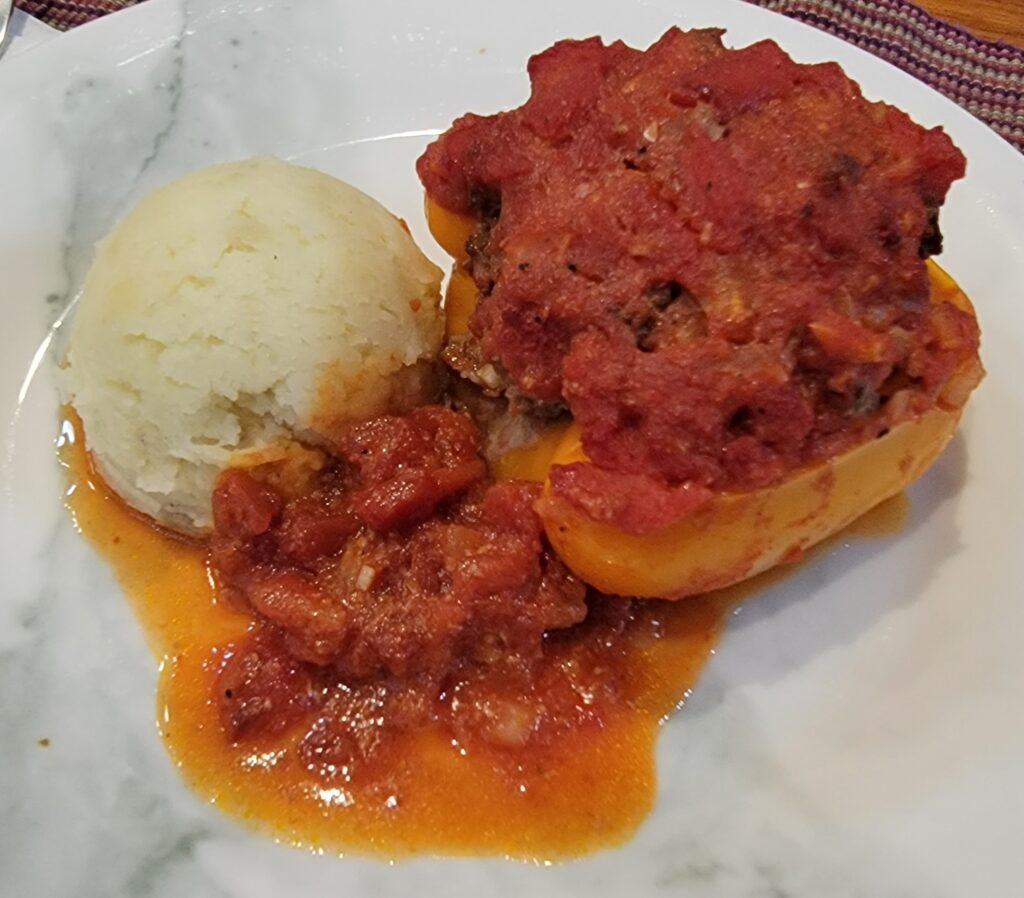
Stuffed Peppers
Make 8 pieces
I use red, orange, and yellow peppers. I don’t like green ones and never cook with them, but if you like them, go ahead and use them. I cut them top to bottom to create little boats for filling. I think it’s easier than cutting off the top and makes a more reasonably sized serving.
The stuffing in this recipe is meat, but you can make it with plant-based meat substitute crumbles. You can also make a stuffing of cooked grains, any veggies you like, chopped small and sautéed. Use bold flavor bombs like fresh herbs, mustard, BBQ sauce, or Asian flavors.
This dish freezes very well. After the first hour of baking, remove from the oven, and cool completely. Wrap the entire baking dish in plastic, then foil, for freezing.
Ingredients
For Sauce
1 lg onion, diced small, 2 TBSP canola oil, 28 oz can tomatoes, crushed or pureed, 2 TBSP agave nectar, ¼ cup fresh lemon juice, 2 tsp garlic powder, 1 cup raisins, Salt & pepper
For Filling
4 bell peppers, cut in half from top to bottom, pith and seeds carefully removed (like boats), 1 lb ground beef, chicken, or turkey, 1 small onion, diced, 2 cups rice, cooked, but not quite done, 1 tsp garlic powder, Salt & pepper
Directions
Preheat oven to 350°
Make Sauce
- In medium saucepan, sauté onions in oil until translucent.
- Add tomatoes, agave, lemon juice, garlic powder, and raisins. Turn to simmer and stir frequently until raisins are plump and sauce tastes good. Season with salt & pepper.
Make Filling & Assemble
- In large bowl, mix meat, onion, rice, garlic powder, salt & pepper.
- Add ½ cup of the sauce to the meat and combine.
- Put ½ cup of sauce in bottom of baking dish.
- Divide meat into eight parts and stuff each pepper half, then place in baking dish. Don’t pack the meat too tightly, but the peppers should fit snugly into dish.
- Cover peppers with remaining sauce and cover dish. Bake at 350° for 1 hour; remove cover and bake for 30 minutes more.
Serve hot.