
It was Rosh Hashanah at shul when I spotted it — one of those oversized, theatrical magnums of Willett bourbon that looked like it belonged in a Lizzy Savetsky Instagram post, nestled between jeweled apples and a monogrammed challah cover. The bottle was shaped like a decanter, tall and gleaming, and took two hands to pour. I couldn’t snap a picture — it was Shabbat — but the visual stayed with me.
If you’ve ever clinked glasses at a Jewish simcha in Cincinnati, the toast probably was made with bourbon. You probably know someone like my husband: refreshing the Ohio Liquor Control website like it’s ESPN on draft day, proudly displaying his “top shelf” collection — and quietly stashing three times as many bottles in the cabinets below.
We’re close enough to the Bourbon Trail that stocking up isn’t a chore. It’s a hobby. A personality trait. A coping mechanism. Or, if you’ve got a whiskey connoisseur in the family, a full-time sport.
And no one understands that better than Rabbi Chaim Litvin — or as he’s better known on the whiskey circuit, the Bourbon Rabbi. He’s been featured in The Wall Street Journal, sought after for tastings around the globe, and is widely regarded as the go-to expert on kosher bourbon and Jewish whiskey history.
So if you’re looking to escape Cincinnati for a weekend of bourbon, history, and a little Jewish pride — or if you’ve got a whiskey connoisseur in the family who’s made the Bourbon Trail a full-time sport — here’s your trail map, complete with kosher pit stops, Jewish heritage landmarks, and a few unexpected detours, according to the Bourbon Rabbi himself.








Friday Afternoon: Hit the Road and Head South
“Start at Boone County Distilling Co.,” the Rabbi said. “It’s close, and it’s one of only a few distilleries making certified kosher bourbon.”
Their Dalton release is especially rare — aged in wine casks from Dalton Winery in Israel. Wine cask finishes are notoriously tricky under kosher law, but Boone County managed it. “There are only three bottles like it in the world,” Rabbi Litvin said. “They worked hard to do it right.”
From there, head south to Louisville and stop at Peerless Distilling Co., where Jewish history and whiskey intersect in a way that’s hard to top.
“Do you want to hear the story?” he asked. “It’s a good one.”
Henry Kraver, the founder of Peerless, was a Jewish immigrant from Poland who landed in New York as a teenager. With a few dollars in his pocket, he got on a train and asked the conductor how far he could go.
“He could’ve gotten off in Louisville,” the Rabbi told me. “But he didn’t. He kept going until he ran out of money — and that’s how he ended up in Henderson.”
Kraver asked the local innkeeper if he could work in exchange for a place to sleep. He did — and stayed for years. Eventually, he bought the bar. Then a brewery. Then a distillery.
By 1907, he’d incorporated Kentucky Peerless Distilling Co., which grew to produce up to 200 barrels a day. “When Prohibition hit,” the Rabbi explained, “they were one of just seven distilleries in the country allowed to keep operating — for medicinal whiskey.”
The distillery eventually closed, but Kraver’s great-grandson, Corky Taylor, brought it back in 2014. Today, it’s kosher certified and offers one of the most transparent tours around.
“You can see everything — the cooking, fermenting, aging — all from one spot,” said Rabbi Litvin. “It’s really unique.”




Sidebar: Kosher Bourbon 101
“People assume all bourbon is kosher,” Rabbi Litvin said. “But that’s just not true. The ingredients are usually fine — corn, rye, barley — but it’s the equipment and facility that make the difference.”
He explained, “In the 1800s and early 1900s, it was easier: distilleries were small, and they just made bourbon. Everyone trusted they were kosher. But now? These places are huge. They make wine, cordials, cream liqueurs — and some of that stuff is definitely not kosher. That’s where supervision becomes necessary.”
“If it’s made in a facility that only produces straight bourbon — and it’s supervised — it’s usually easier to certify,” the Rabbi said. “But you should still look for a hechsher or check bourbonrabbi.com to be sure.”
Saturday: Shul And Heaven Hill
Yes, it’s Shabbat. And yes, ideally, you’re at shul. But if you’re already in Bardstown — and you’re walking — who’s to say you can’t fit in a little spiritual enrichment of the bourbon variety?
“This is where you really start to understand scale,” Rabbi Litvin told me. “These places are massive. It’s a completely different experience than the smaller, craft distilleries.”
Start with Heaven Hill, one of the largest family-owned bourbon producers in the country. “It was founded by the Shapira family during the Great Depression,” he said. “And they still run it today.”
When I asked him for his favorite bottle, he gave a short laugh. “Well, obviously mine. But if I had to pick something else? I.W. Harper.”
That bottle comes with one of bourbon’s best Jewish backstories. I.W. Harper was originally created by Isaac Wolfe Bernheim, a Jewish immigrant from Germany. “The ‘I.W.’ may have stood for his first and middle names, but he chose ‘Harper’ as the label name — possibly for marketability, possibly to mask his Jewish identity. There’s even a rumor he named it after his stableman,” Rabbi Litvin said. “But really, it was just smart branding.”
In 1992, a large distilling plant called the Bernheim Distillery opened in Louisville, operated by United Distillers (then owned by Guinness). After a 1996 fire destroyed Heaven Hill’s Bardstown facility, they purchased the Bernheim site in 1999 and made it their primary distilling plant, and in 2015, they returned I.W. Harper to the U.S. market, using whiskey distilled at the new Bernheim facility — tying the brand, once again, to its Jewish roots.
Looking for a shul nearby? Chabad of Louisville might be able to help, since Bardstown isn’t exactly teeming with minyans. Heaven Hill may be kosher, but it’s not setting out a kugel.
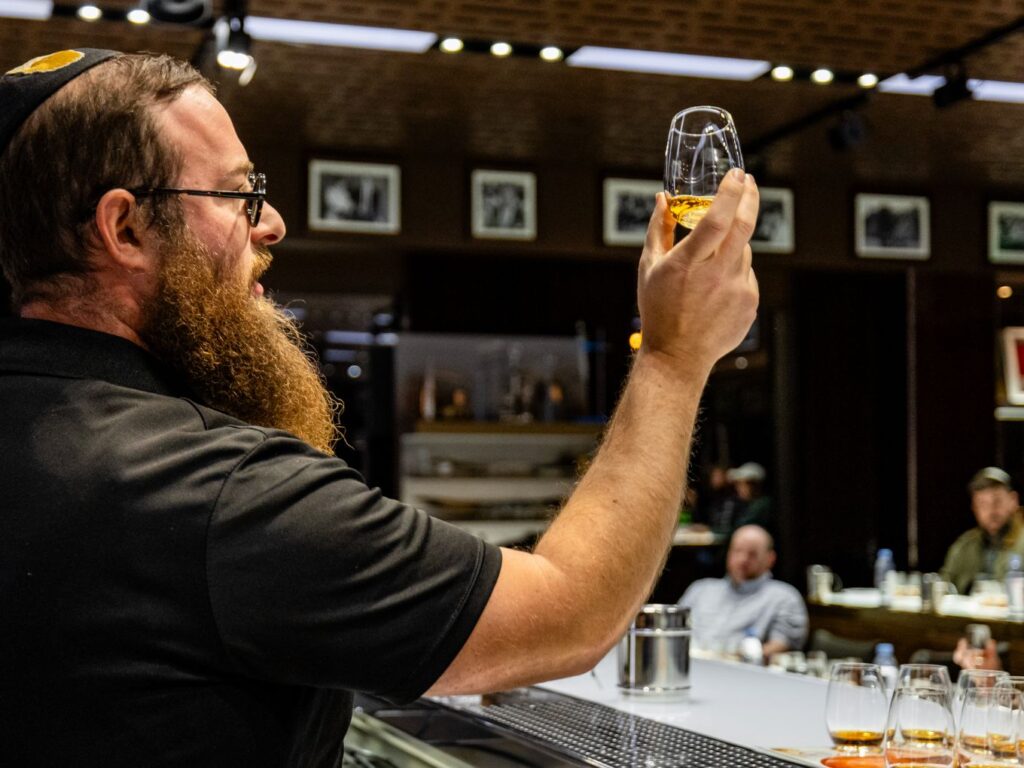
Saturday Night: A Private Tour with the Bourbon Rabbi
If you’re staying overnight (and you should — this isn’t exactly a driver-friendly itinerary), your last stop of the day is a private, after-hours tour of the Bourbon Rabbi’s distillery in Shelbyville.
It’s a small operation, which is part of the charm — and why tours happen in the evening, by appointment only.
“We only do private tours,” Rabbi Litvin said. “Usually in the evening — once we shut down production. That way people can see everything.”
Rabbi Litvin’s bourbon journey started with kosher supervision — visiting distilleries, asking questions, checking processes. “In 2017, the Wall Street Journal did a piece on me,” he said. “That’s when things really took off. I started doing tastings around the world — Israel, Australia, South Africa — and everywhere I went, people asked me, ‘Which one is yours?’”
For a while, he didn’t have one. But in 2021, that changed.
“I finally said, ‘I need to make my own.’ So I did. We started a distillery in Shelbyville — nine lines, all certified, all intentional.”
And at the end of the tour, just when you think you’ve seen it all, you spot it: the gold-foil label, the bold initials — and a bearded silhouette that looks suspiciously familiar.
Sunday: Stock Up, Then Circle Back
Your journey’s almost over, but before heading home to Cincinnati, there’s one last stop worth making: New Riff Distilling in Newport, just across the river.
New Riff is one of the few distilleries in the country to offer a year-round, kosher-certified Single-Barrel Bourbon, and the local Jewish community has embraced them.
New Riff even hosted Cincinnati Kosher’s recent fundraiser, a testament to how seriously they’ve taken their relationship with the community. With plans to expand their kosher offerings — including a rye — they’re becoming a real force in the market.
But before you cross back into Cincinnati, stop by The Party Source, located just across the street, to stock up for your next L’Chaim. You’ll find bottles from New Riff, Heaven Hill, Boone County, and — of course — the Bourbon Rabbi.
And with the High Holidays just around the corner, now’s the time to stock up — whether it’s for your break-the-fast, your Rosh Hashanah tablescape, or just to make your sukkah the most popular one on the block. Because a good bottle of bourbon — and the story behind it — always goes down smooth.