

Books have always been an essential part of my life. Call me old-fashioned, but I prefer the feel of a book in my hand, the pages crisp and fresh from a bookstore, or the smell of musty old pages from a library, over a Kindle or iPad. Even before I could read, I spent hours gazing at picture books, imagining the stories their illustrations depicted. I remember sitting with my mother and father, Fun with Dick and Jane open in my lap, learning to read. The moment I realized that letters formed words—and words, ideas—was, for lack of a better term, magical. That moment paved the way for a lifelong love of reading.
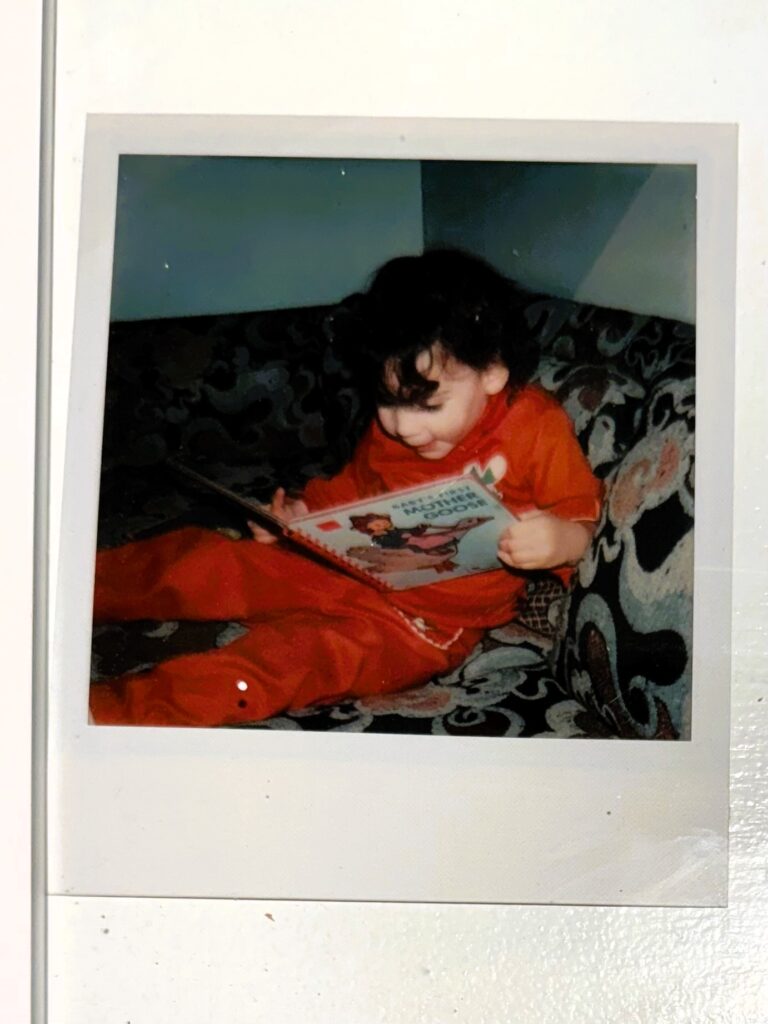
The author reading as a child (courtesy)
The first time I truly fell in love with books was when I was in my temple’s library in elementary school.
As I browsed the shelves, my eyes landed on a book cover that immediately caught my attention: five young girls dressed in pretty aprons and boots stood beneath a tree, holding flowers in their hands. I could almost hear their laughter and chattering voices before I turned to the first page.
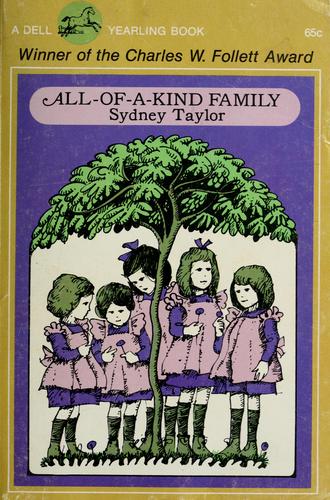
Cover art from All-of-a-Kind Family, circa 1980s (Openlibrary.org)
I checked out All-of-a-Kind Family by Sydney Taylor and took it home.
The moment I started reading, I was immersed in the story. I instantly felt a bond with Ella, Sarah, Henny, Charlotte, and Gertie, sisters living a quiet Jewish life on the Lower East Side of New York in the early 20th century. The story, as the title suggests, revolved around their close-knit family. I had already enjoyed books with this theme, books like The Boxcar Children, Little House on the Prairie, and The Five Little Peppers and How They Grew. But here, on these pages, were young girls like me who were Jewish.




I could relate not only to their everyday concerns, like worrying over a lost library book, but also to their religious experiences. This was the first time I saw my faith and culture reflected in a novel. They celebrated Hanukkah and Purim, observed Shabbat, and belonged to a loving family just like my own. After finishing the first book, I eagerly read the entire series. These stories left a lasting impression on me not only as a reader, but also as a writer who would later find her calling in telling stories about family and faith.
Another book from my childhood that deeply influenced me as a Jewish reader was The Carp in the Bathtub by Barbara Cohen. This story about a brother and sister who grow attached to a live carp kept in their bathtub the week before Passover, until their mother prepares it for gefilte fish, kept me turning the pages. I became invested in the fate of the carp who they named Joe and attempted to rescue. I’m surprised I didn’t become a vegetarian after reading it, but that’s perhaps why I now don’t eat gefilte fish! The whimsical illustrations by Joan Halpern added beautifully to the narrative. Once again, I was drawn to familiar characters who may have lived in a different time and place than me, but shared the same traditions. We ate the same foods, said the same prayers, and celebrated the same holidays, in particular, Passover.
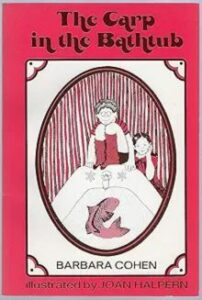
Cover of The Carp in the Bathtub (Amazon.com)
I always associate these books with my synagogue’s library.
I loved that quiet room where everyone spoke in hushed whispers. One half was lined with textbooks and prayer books, but it was the children’s section that became a second home to me during Sunday school. It was there that I discovered through literature a sense of belonging and being part of something greater than myself.
As I grew older, I began to explore books that dealt with heavier subjects. My growing awareness of my family’s personal experiences during the Holocaust led me to read any book I could find on the subject. At first, I read age-appropriate books that introduced the horrors of the Holocaust to younger readers, books like The Upstairs Room by Johanna Reiss and, of course, The Diary of Anne Frank. My growing library of Holocaust-themed books inspired me to write my first novel, What She Lost, based on my grandmother’s experiences. I hoped to add to a genre that some might argue is already oversaturated, but I believe every story deserves to be remembered, especially as those who witnessed the Holocaust firsthand will soon no longer be here to share their accounts. History must not be forgotten.
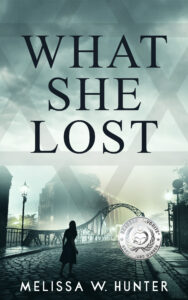
Cover of What She Lost (Cynren Press) (photo courtesy)
When I became a parent, I introduced my children to many of the stories that had meant so much to me in my youth.
I hoped to instill in them not only a love of reading and storytelling, but an appreciation for Judaism in literature. We are, after all, the People of the Book. Sitting beside my daughters after they were tucked in bed, watching their eyes grow heavy as I read to them softly, reminded me once again of the magic books hold.
Below is a list of some of my favorite childhood and young adult books with Jewish themes or written by Jewish authors. I feel these books would be a great addition to any library. Now, as an adult, I look forward to discovering more titles and sharing them with you!
- Tevye the Dairyman and The Railroad Stories by Sholem Aleichem
- Are You There God? It’s Me, Margaret by Judy Blume
- Starring Sally J. Freedman as Herself by Judy Blume
- The Carp in the Bathtub by Barbara Cohen
- The Diary of a Young Girl by Anne Frank
- Hershel and the Hanukkah Goblins by Eric A. Kimmel
- Number the Stars by Lois Lowry
- The Chosen by Chaim Potok
- The Upstairs Room by Johanna Reiss
- The Giving Tree by Shel Silverstein
- Maus by Art Spiegelman
- All-of-a-Kind Family series by Sidney Taylor
- The Devil’s Arithmetic by Jane Yolen
- It Could Always Be Worse by Margot Zemach
- The Book Thief by Markus Zusak