

Who the Folk?! Cincinnati is Cincy Jewfolk’s new podcast spotlighting the diverse voices shaping Jewish life in the Queen City.
Hosted by Cincy Jewfolk’s editor Sam Fisher, the series features conversations with notable and fascinating Cincinnati Jews—from artists and entrepreneurs to community leaders and culture-shapers.
Each episode dives into personal stories, passions, and perspectives, showing that Jewish life here is anything but one-size-fits-all.The Who the Folk?! Cincinnati podcast is part of the Jewfolk Podcast Network and a product of Jewfolk, Inc.
If you have suggestions for Who the Folk?! Cincinnati podcast guests, please fill out this form.
Be sure to check out the entire series and follow along as Sam interviews and features notable Cincy Jews & Jews doing interesting things in the Queen City!







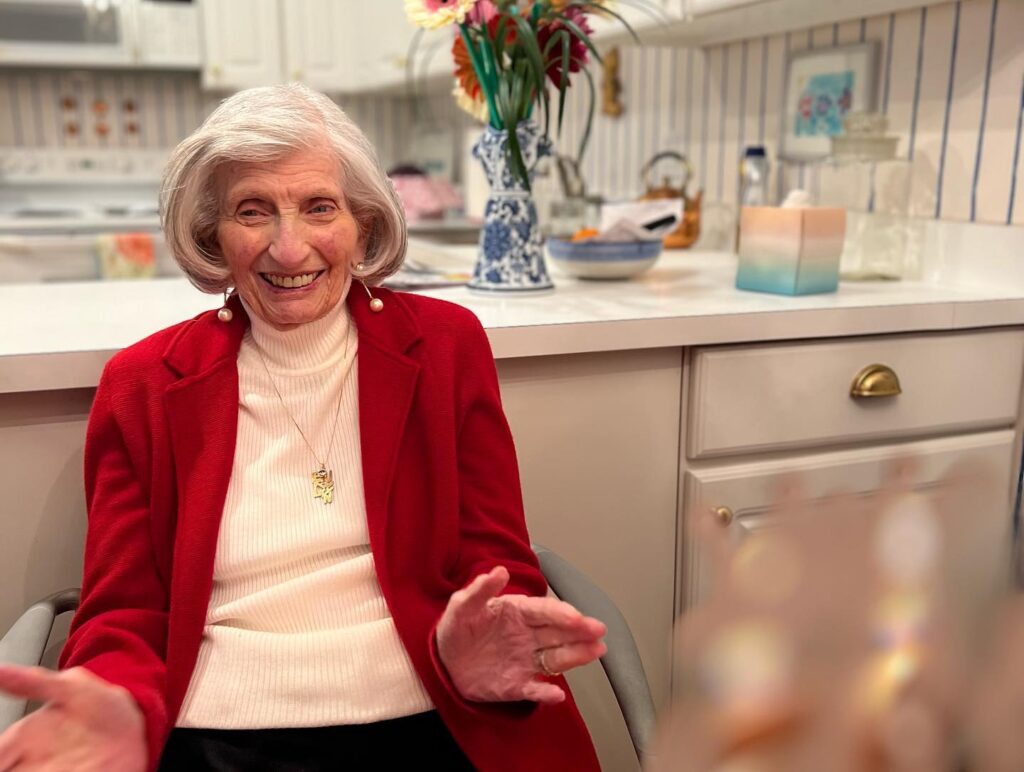
Introducing this week’s WTF?! Cincinnati’s guest
Evelyn Fisher is a first-generation American. She was born in Augusta, Kentucky, the eldest of three siblings. Her family moved to Cincinnati, and she has been a lifelong Cincinnatian since. She is a graduate of Hughes High School and the University of Cincinnati.
Evelyn is a supporter of the arts, theater, and an amateur Jewish art collector. She is a mother, grandmother, and great-grandmother. She recently celebrated her 97th Birthday. She still lives in her condo here in Cincinnati. She’s a true optimist, and still does her daily crossword with a pen.
Listen to this podcast episode
A note for you
Below, you’ll find a full transcript of this interview. We provide these so that you can read along, catch anything you might have missed, or revisit your favorite moments.
We do our best to make sure everything’s accurate, but if you spot a typo or mistake, that’s on us. We hope you’ll enjoy listening — and reading — along!
Show transcript
Sam: Welcome everyone to this week’s episode of Who the Folk Cincy. I’m Sam Fisher. I’m the editor of Cincy Jew folk, and this week, I got to sit down with Evelyn Fisher, and you might notice that we share the same last name, and that’s because that is my 97 year old grandma. Calling her Evelyn feels a little strange. She is a first generation American. She was born in Kentucky, but then moved to Cincinnati right after, she tells us stories about growing up her, old haunts down at the University of Cincinnati, how she and her friends might have thrown a party to get a guy’s attention. And she shares some wisdom and a few jokes with us on this week’s episode of Who the Folk.
This week’s episode is sponsored by Downlite. Ever wish your pillow felt like a cloud? Meet the cloud top pillow enhancer from Downlite Bedding. It transforms any pillow into a plush, cloud like dream, perfect for refreshing tired pillows without having to buy new ones. Filled with hypoallergenic down alternative. It delivers softness, support and lasting comfort. Night after night, visit www.downlitebedding.com and sleep in comfort like never before. Use coupon code JF20 for 20% off. More comfort, more cozy at www.downlitebedding.com.
Evelyn Fisher, welcome to Who the Folk, Grandma. Thanks so much for coming on Who the Folk today. And, you know, I like to start a lot of my interviews to say, with the same question, and the first question is, always, are we related? That’s the first question, because it’s a Cincinnati podcast. But I think everybody knows the answer to that, and that’s yes, very, very much.






Evelyn: I’m Sam’s Grandma.
Sam: That’s right. And the next question, which is also an easy question, but maybe not an easy question, for question for you, where are you from?
Evelyn: I’m from Cincinnati, Ohio.
Sam: From Cincinnati, Ohio, but where are you from, originally? You moved here when you were young, but before then, where did you live?
Evelyn: My parents lived in Augusta, Kentucky, and then they moved to Cincinnati after that, day after I was born, and I was born a Jewish Hospital in Cincinnati.
Sam: That’s right at the origin, the original location in Clifton.
Evelyn: Yes.
Sam: And when you were growing up, was there something that you aspired to be? Was there something that you wanted to be that sort of drew you when you were a kid?
Evelyn: I can’t remember anything when I was a kid, no, I always liked interior decorating, and I thought I could be one, but I don’t have the artistic talent for it, so I just enjoy it when I see it.
Sam: You enjoy it when you see it. And growing up? You grew up in Avondale, right? Or did you grow up?
Evelyn: Yes, yeah.
Sam: And what did your, your parents do for work?
Evelyn: My father was an insurance man for a while, and then he went into business down on Lynn Street in the West End, and he had a fish and poultry market.
Sam: He was a butcher sort of.
Evelyn: Yeah, he, I never went down there to work for him. And my two brothers did,
Sam: Yeah.
Evelyn: They had to work for him every Saturday,
Sam: Every Saturday on Shabbos? That’s very progressive.
Evelyn: Well, needed to help.
Sam: And what did your mom do?
Evelyn: My mother, when she worked, she was a very good seamstress. And she had a job with a company that made mostly winter coats and heavy clothing.
Sam: Yeah.
Evelyn: I can’t remember the name of the company, but it was downtown.
Sam: It was downtown?
Evelyn: Yeah. And I remember her complaining in the summer that it was so hot, to work on a winter coat in the summer,
Sam: Yeah.
Evelyn: Because they didn’t have air conditioning in the summer, sewing room.
Sam: And it was probably just a windowless room downtown.
Evelyn: I don’t remember, I don’t know.
Sam: Yeah, you never had to go.
Evelyn: Yeah, but they finally had a union come in and got them air conditioning and some better working conditions.
Sam: Was your mother involved with bringing the union? Was she involved with, like, organizing?
Evelyn: Not to my knowledge.
Sam: Not to your knowledge.
Evelyn: Other people were doing that.
Sam: Growing up, what language did you speak at home? Did you speak English, or was it something else?
Evelyn: English. My parents spoke a lot of Yiddish when they didn’t want us to understand what they were saying, but then we caught on.
Sam: You caught on. You learned, eventually.
Evelyn: We learned it. And my Bubbie, my mother’s mother, would always read to us from the Yiddish, Jewish paper.
Sam: In Yiddish. So you’d understand.
Evelyn: But she understood when we’d talk to her in English.
Sam: Yeah, but she could only speak Yiddish, your grandma?
Evelyn: Yeah, she only spoke Yiddish.
Sam: And, you’re a first generation American.
Evelyn: Yeah.
Sam: When did your parents, do you know, do you remember when your parents came to the states? Was it, before they were married? After they were married?
Evelyn: After. No, before they were married. They weren’t married, I don’t even think they knew each other when they first immigrated here. And through their memberships with a lot of the Jewish groups, Zionist groups, they met.
Sam: They met.
Evelyn: Yeah.
Sam: From Jewish youth groups.
Evelyn: Not that, no,
Sam: Young adult groups.
Evelyn: They were teenagers when they came. They were like early 20s maybe.
Sam: And growing up, were you involved in any of those sort of groups? Were you involved with,
Evelyn: Yeah, my mother entered me, I joined this club called Habonim.
Sam: Habonim.
Evelyn: Yeah, we learned dances, and one year, a couple of years, they had a camp, and my mother got the, well, I don’t know how she did it, but my brother and I had scholarships to the camp,
Sam: Yeah. So you got to go!
Evelyn: Yeah, we got to go. And it was in Michigan.
Sam: It was in Michigan. How long were you there?
Evelyn: You know it wasn’t, I don’t even remember, at the time, I know it was a couple of weeks each time.
Sam: Oh yeah you went multiple summers?
Evelyn: Yes.
Sam: And do you remember anything about the camp, what you all did? Was it just learning those dances and summer activities and swimming and things like that, or?
Evelyn: It was pretty normal a camp. But everybody there was Jewish. And you gotta remember, this is when I was maybe 10 through 12, so I just remember a lot of the people there. And, we had a good time, we had good food, and one summer my brother Herschel, the older of the two boys came to camp and then he got sick, he had a cold, poor thing, and they made him stay in his tent.
Sam: They quarantined him.
Evelyn: They quarantined him.
Sam: Because he had a cold.
Evelyn: I had to go visit him.
Sam: Oh no!
Evelyn: He got better.
Sam: He got better. Yeah, yeah. That’s funny that they made it, that they made him stay in his tent.
Evelyn: Well they didn’t want him to give it to the other kids.
Sam: No, it makes sense. It makes sense. Just imagine if that would have happened now.
Evelyn: Oy.
Sam: Oy vey, right. You know you went to summer camp as a kid, and then where did you end up going to high school. I know you went to high school locally, because that leads us kind of the next, the next phase of your life, which is
Evelyn: I went to Hughes high school,
Sam: High school, and then Hughes high school, didn’t you join? Did you join a sorority in high school, or was that in college, your sorority?
Evelyn: We actually, I joined a sorority in high school, but it was not a known thing. It was just a few, it was just a few people
Sam: Just a few, yeah. A few of you got together and said let’s make a club.
Evely: Yeah.
Sam: And when did you start getting involved? Because you’ve always been involved in theater. You’ve always liked art. I know you’ve done things with stage crafters in the past, a lot of behind the scenes sort of work. When did you start to get involved in that?
Evelyn: Well, I was after uncle Stan passed away, and I have had a cousin named Gitty Boards, who was actually in an acting school here in Cincinnati called Shuster Martin, and that’s where, oh, God, I can’t remember his name. This very famous actor. His aunt and uncle owned it, and he went to school there too.
Sam: Yeah. So you didn’t remember it,
Evelyn: When I remember it, I’ll tell you.
Sam: So when you were in college and high school, you weren’t, you didn’t really get involved in that sort of thing. That wasn’t your–
Evelyn: No, I came to watch her play at that theater.
Sam: Yeah, that’s involved, you were involved.
Evelyn: It was the Shuster Martin drama school.
Sam: Yeah, and it’s what kind of Gitty performing there and studying there is what got you into it?
Evelyn: Yeah, because I wasn’t interested in performing.
Sam: No, you didn’t want to get on stage. Which is funny, because one of your children and more than one of your grandchildren are interested in performing.
Evelyn: That’s very true.
Sam: Yeah, so you’re at Hughes High School. Do you remember anything? What was going to Hughes High School? Like, back in the, that would have been the 40s, right?
Evelyn: It was fine. Typical, yeah, typical high school. We had a good team, football team, and one of my best friends went there too,
Sam: Yeah.
Evelyn: And it was a funny thing the first day of school, first day for us, for high school, yeah, we came into this classroom we were assigned to, and they were out. They ran out of seats. They were one seat,
Sam: They were one seat short.
Evelyn: So she made both of us sit in one desk. The teacher.
Sam: They made you share a chair?
Evelyn: We shared a desk and chair, yeah.
Sam: You had to share it.
Evelyn: But that was just for homeroom.
Sam: Just for homeroom, okay, that’s good, it wasn’t like a full, no class. You had to sit there for, you know, an hour. Funny,
Evelyn: We were both in, yeah, so she said, You two can say,
Sam: Is this your freshman year? Oh, man. So they just were hazing the freshman,
Evelyn: It wasn’t really hazing.
Sam: A little bit.
Evelyn: Poor teacher didn’t have another chair.
Sam: That’s funny. And sort of, when you were in high school, what sort of things did you, were you involved with? Were you still involved with, like Habonim or youth groups and things like that? Or was it just, sort of, you’re just trying to get through it?
Evelyn: We joined some of the activities that the school did, and I don’t know, the years passed, we had a good time.
Sam: Yeah, you had a good time. I remember you telling me that you used to go to Mecklenburg gardens.
Evelyn: We went. That was that more in college,
Sam: Because you could go drink beer at Mecklenburg gardens. You wouldn’t try that in high school, that’s for sure.
Evelyn: I would look down on that.
Sam: Okay, that’s good. And during that time, you know, you’re studying, and was it always your goal to go to UC, was it your goal to get into college? Or were you looking to do something else after high school?
Evelyn: No, I wanted to go to college. My family wanted me to go. Yeah, so I did.
Sam: So you did,
Evelyn: But I lived at home. I didn’t live in a dorm, yeah, because we couldn’t afford it then.
Sam: Yeah. What did you want to study and what did you end up studying?
Evelyn: Good question
Sam: Yeah. Well you’ve got a degree.
Evelyn: I do have a degree. I don’t know, I was more with like, some of the home ec programs, and part of that is, they have a nursery school at UC in our building and sometimes we would go work up there.
Sam: You, they would have you go, work with kids, yeah, with infants I guess.
Evelyn: These were children of, usually the faculty.
Sam: Okay.
Evelyn: They were, you know, real students. Real students there, the little ones, yeah, and it was fun. And I don’t know, we spend a lot of time with our friends from the well, not so much the high school sorority, but the college sorority.
Sam: And how did you get involved with your college sorority? What made you want to join?
Evelyn: There was a friend of mine, and she was a year older than than I was, and my good friend Shirley, we were the same age, and she was in this sorority, and she wanted us to join. So we did. It was very, it was very much fun with us. Yeah, and
Sam: Did they make you go through any like rituals to join where they’re like,
Evelyn: There’s always a pledge thing but no, nothing
Sam: Nothing crazy.
Evelyn: Nothing crazy.
Sam: And what kind of things did you do in your sorority?
Evelyn: Well that’s all social. We had a meeting every week, and we would plan like sometimes we did parties or dances or so forth. It’s all social. But some of it, I remember, was where we gave to people. We had a group that would go to schools and and children who needed things. We would go out and get them, like a pair of shoes, or, you know, clothing, yeah, because my friend Betty was in the teacher’s college and wherever she worked, she told us what the needs were for the kids at the school. So we did a lot of that.
Sam: That, yeah, so you’d go out.
Evelyn: And help them out, yes, and get donated to them. Donate to them.
Sam: Were there anything? Was there anything that that you did that kind of really sticks out? Were there any parties that you threw, or any any wild times that you had that you remember?
Evelyn: Not really. No, I was very I was too shy.
Sam: You’re too shy.
Evelyn: I’m sorry.
Sam: That’s okay. Did you ever, did you like going, like, football games or basketball games, or do you didn’t really go to those yet.
Evelyn: We went to some of them.
Sam: Yeah, some Yeah. And kind of, what was the impetus of going to? I mean, we both know you liked Mecklenburg gardens because you’ve mentioned it, oh, more than once,
Evelyn: Because it was just so close to campus.
Sam: It was just so close?
Evelyn:I didn’t drink, and I tried to learn to drink beer and I didn’t like didn’t like it. So that was the end of that. But their food was very good.
Sam: How did they try to get you to learn? How did you try to learn to like drinking? How did you go about it? Or somebody
Evelyn: Trying to just taste, just tasted it.
Sam: Just didn’t like it.
Evelyn: Just didn’t like it. But the food was good there. They made hamburgers that were fabulous.
Sam: Yeah?
Evelyn: In those days they had great food.
Sam: Maybe one day they’ll have great food again, because it’s been closed down for a couple of years now.
Evelyn: It has? Wow. I didn’t know that.
Sam: Sadly.
Evelyn: Yeah.
Sam: So it was while you’re in college. Is that how you met? Met Stan? When did you meet Stan?
Evelyn: Actually it wasn’t.
Sam: It wasn’t!
Evelyn: No, it was right after college. We used to go to the Jewish Center a lot, yeah, and I and one there was one time my cousin Gitty Boards the actress just said she was going to this meeting. And I said, Well, could I have a ride? Yeah, because she had a car, and so she picked me up and took me to this meeting.
Sam: Do you remember what the meeting was for?
Evelyn: Yeah, they were trying to form a group for that age group. Yeah,
Sam: They’re trying to start like a young adult, yeah,
Evelyn: After college.
Sam: Yeah, young adult, it’s something they’re still trying to do.
Evelyn: So I went with her, and it was nice you know, a lot of people there, some that I knew, and it was successful, at least the Center thought so, and they kept on with different groups, there was a group that published a newspaper, there were groups that did theater,
Sam: Yeah, all sorts of groups.
Evelyn: And so the meeting was over, we got ready to leave, and this guy walks up to me, and he says, Can I help you on with your coat? Because I was holding, yeah. And I said, Oh, thank you. And what else? He said, that’s a pretty coat. I said, thank you. And he said, Do you need a ride home? And then Gitty, was there with me there, Standing there, And I said, and I didn’t know what to say,
Sam: Yeah, I mean, yeah, you’re feeling a little shy?
Evelyn: Because I looked at Gitty and Gitty said, go ahead and go,
Sam: Yeah. She’s like, Yeah. She’s like, I’m not here. Is that what she’s kind of doing, yeah, yeah. She was being a good wing woman, as they say, yeah.
Evelyn: Is that what they say?
Sam: Yeah,
Evelyn: That’s funny. Anyway, he took me home. He was very polite and all that. And that was it. I didn’t see him anymore.
Sam: Yeah,
Evelyn: I can’t remember how many weeks it was.
Sam: Did you have a conversation on the on the drive home? Or, I guess, but it must have made an impression a long time ago. Yeah, but it made an impression, right?
Evelyn: I suppose
Sam: You suppose, okay.
Evelyn: And I didn’t hear from, I didn’t hear from him, so I decided to give a party at my house, yeah, and a number of my friends came, some with boyfriends, some without,
Sam: Yeah.
Evelyn: Didn’t matter. My mother made the dinner like, I think it was meatballs and spaghetti, yeah, and and we all played, you know, when you act out a,
Sam: Charades?
Evelyn: Charades. We played that game that night, and it was lots of fun. So a few weeks after that, he called me.
Sam: After the party?
Evelyn: Yeah.
Sam: Was he at the party?
Evelyn: Yes. I invited him, he came.
Sam: Okay, we missed that part.
Evelyn: I forgot to tell you. He came, he came very late, he said he’s sorry he was late, he had to babysit with his little brother. That’s Mendy.
Sam: Mendy Fisher.
Evelyn: Mendy was 17 years younger than him. And, because his mother, his father had been hurt in an auto accident and had a continuing problem. So his mother had to work in the paint store. So his mother had to work that night, so he had to wait until she got home.
Sam: Yeah, okay, but when you were kind of coming up with the idea of the party, was the idea to get him to come to the party?
Evelyn: Yes,
Sam: Okay, did you did you have, like, a name for it? Did your friends call it something like, was it a specific kind of party?
Evelyn: Well, we didn’t then, but later my friends said something about a “get Stanley party”,
Sam: It was a get Stanley party.
Evelyn: Is this going on in public?
Sam: Yeah, yes.
Evelyn: That wasn’t my name.
Sam: Okay, you didn’t come up with that?
Evelyn: No.
Sam: Okay, it was probably Gitty or something that came up with it.
Evelyn: Yeah, maybe so.
Sam: Maybe, okay, so he came, he showed up late because he had to babysit,
Evelyn: Yes, and then, and happened pretty often, because he
Sam: He was just late all the time?
Evelyn: Because he had to babysit.
Sam: Not because of Jewish Standard Time.
Evelyn: No. You know, she had to work until, evening hours too sometimes, especially on weekends.
Sam: Yeah. So you didn’t hear from him for a couple of weeks after the, we’ll call it the “get Stan party”, but after that,
Evelyn: Don’t call it that.
Sam: Okay, we won’t call it that. After that party where you played Charades, you didn’t hear from him for a few weeks, right? Or was it several weeks?
Evelyn: I don’t remember.
Sam: You don’t remember?
Evelyn: It wasn’t too far away. I didn’t keep a diary in those days.
Sam: Do you keep a diary now? Have you ever kept a diary?
Evelyn: No.
Sam: So I guess it’s a good thing you never kept a diary then.
Evelyn: Yeah.
Sam: So it took a little bit and then he finally called you.
Evelyn: Yeah.
Sam: And then you started dating. And how soon after that did you get married? Do you remember?
Evelyn: Well, that was, wasn’t too far. Let’s see, we met maybe in early fall. We got married around Christmas, it wasn’t long.
Sam: Yeah, because you got married on the equinox,
Evelyn: I did?
Sam: Yes, at least that’s what I’ve been told.
Evelyn: Okay,
Sam: Yeah, the shortest night of the year, it’s like, December, yeah?
Evelyn: Oh yeah, What? That’s right, everybody was teasing, yeah,
Sam: December or the longest night of the year, the shortest day of that year, yeah,
Evelyn: It was around Christmas time because my brothers and his brother were all in school, yeah, we had to wait till they got off school from, you know, we had to wait until everybody
Sam: Everybody was off of school, yeah,
Evelyn: On vacation.
Sam: And was it a was it a big wedding, a small wedding, a medium wedding?
Evelyn: They had a lot of relatives, and we did too, so it was bigger than we wanted,
Sam: bigger than you wanted. You wanted, a small affair,
Evelyn: I think so. Yeah, we did. He did. I know you did. And mother kept inviting more people, but that was okay, yeah, nobody got mad at any
Sam: No, nobody got mad that there were too many people. So many people. Okay, well, I mean, it sounds like a pretty Jewish affair that more and more relatives come out of the woodwork.
Evelyn: Yeah, yes, I had relatives came in who came in from out of town, yeah, and so did he, yeah, and it was, it was fun. It was
Sam: It was a good time, I’m sure. And during that time, were you What were you up to after after college, you graduate, you got your degree, what are you up to after that? Besides throwing, you know, parties to trap, to trap, Grandpa, what else are you doing?
Evelyn: I had a job at Shillitos, Shillitos department store, and I was in there. I don’t know what. I can’t remember now what they called it something, training program, the train, training us to be become buyers and assistant buyers. And they had another position there, head of stock,
Sam: Head of stock, yes,
Evelyn: And I wanted to do that, yeah. And. I did. I went through the school, the Shillitos school.
Sam: The Shillitos school, yeah. And have you been back, have you been down there? Have you seen kinda what it is now?
Evelyn: Shillitos?
Sam: Shillitos, yeah, it’s all luxury apartments.
Evelyn: I know that, I haven’t seen it. I saw when Gary had a store down there in the lobby of the hotel around the corner, I saw, I went up and saw some of their lobby but I didn’t see their rooms.
Sam: And so you’re doing that, you get married, working at Shillitos. Do you keep working at Shillitos after you get married, or no, you’re done kind of a that’s,
Evelyn: Kind of, I’m sorry I did work when we were married. When you were married, I quit work when we were I was pregnant, yeah, because they had a rule at Shillitos that if you when you get to be five months old pregnant, you have to quit or take a big vacation or something, take time off, really, they wouldn’t be responsible for us. I don’t think it could pass today.
Sam: I mean, it’s, it’s pretty similar. I mean, it’s changed, thankfully, a lot, but not that much, really. Yeah,
Evelyn: I didn’t know that. But you know, I was raising him, and then we had other kids.
Sam: Yeah, you have four boys, yeah. So what was it like raising four boys? Was it, was it?
Evelyn: It wasn’t too bad at the time. It went pretty well I thought.
Sam: Yeah, they’re all functioning adults with families and careers and lives.
Evelyn: Hopefully. They’re doing their thing.
Sam: Yeah. Which one’s your favorite?
Evelyn: All of them.
Sam: Oh, okay, sorry, that was a gotcha question. I won’t do any more like that. I promise.
Evelyn: That’s okay.
Sam: That’s all right. I should ask the real question is, which one of your grandchildren is your favorite? But I won’t ask you that one either.
Evelyn: No, you can’t, right here. I already know that.
Sam: I already know the answer. I think so. I’ve got an idea, okay, but I won’t say,
Evelyn: Okay, good. And and, you know, it was a very busy time for us,
Sam: I’m sure. Yeah, but yeah, what was going on at the time of the wedding?
Evelyn: My one brother Perry, who ended up in med school, was stationed in Alaska because he was in the service, yes,
Sam: because this was right after, basically, right after the war kind of ended, right,
Evelyn: Yeah, and it was, um, they allowed you to finish college if you were close and then you could go.
Sam: Then you could get drafted.
Evelyn: So that’s what happened with him. And he got stationed there. And he got friendly with a couple, Stan, Stanley Lucas and his wife, Judy Lucas were he was stationed there,
Sam: Yeah, he got friendly with another, with another Jewish couple up in Alaska.
Evelyn: And he was a doctor, yeah, and he sort of, and my brother told him that he was kind of interested in being in medicine, so he got people for him to talk to, and so got him started in Alaska, yeah, so he could go to medical school. He went to medical school in Cincinnati, yeah. And then after that, he moved to Tampa, Florida for his residency and such, and he’s still there,
Sam: And he’s still there, yeah, he’s like “winter no more for me”.
Evelyn: I guess after Alaska he wanted warm weather.
Sam: I mean, I don’t blame him,
Evelyn: I don’t blame him either.
Sam: That’s, Cincinnati winter and Alaska winner are sure are different. And you know, kind of during this time during your life, are you involved in, you know, Jewish life? Are there, are there Jewish things? There are Jewish organizations that you’re getting involved in during this time, or is it you’re just focused on raising the boys and,
Evelyn: Oh, then. Mostly probably was the Sunday school or whatever we had to do or whatever we had the opportunity to do, we did that
Sam: Yeah. What sort of things were there, do you remember? If not it’s okay.
Evelyn: Just activities I think mostly from the school.
Sam: Do you have, I mean, you have a lot of Jewish art around the house. Was that something you were always interested in and always sort of collecting, or did that come? When did you start collecting those sorts of things?
Evelyn: No, My mom started, in this next room. There’s, a series of pictures, and each picture predicts one of the 10 Commandments, okay, I’m missing one or two, but she couldn’t find them either. But we had them hanging, well, my parents did first, and then they moved to a smaller place, and so
Sam: Did she kind of get you hooked on collecting Jewish art? Things like that?
Evelyn: If I saw something, I would get it. Like this picture on the wall is by a famous artist and it portrays the, you know the, I’m forgetting, the Levy tribe, of the twelve Tribes of Israel, because that’s my fathers’ tribe.
Sam: He was a Levine. Which was anglicized as “Levine”. Yeah. Was there something for you that kind of grounded you in your Jewishness? Jewish practice or teaching? Something that made you feel more Jewish?
Evelyn: We kind of just lived it at home. With my friends, mostly. That was our way of life, that was it.
Sam: Yeah, that was just sort of what you did.
Evelyn: It is.
Sam: And when you were growing up, did you ever do any sort of traveling, besides going to Michigan for summer camp? Did you ever,
Evelyn: This was later when I was still in a sorority in college, a friend of mine used to come to Atlantic City to work in their Kosher Hotel, and so she said “you know what I bet you could get a job or I could get you a job there”. So she did, and the guy was, um, he was really a tough guy to work for.
Sam: Yeah, your boss was?
Evelyn: Yeah, in Atlantic City.
Sam: What was your job?
Evelyn: I was a waitress. Trained to be a waitress. We told him we were, Ida Mae had been there before, when I went back for her second year, they made me follow a waitress to learn the job.
Sam: She went back for her second year, it was your first.
Evelyn: Yeah. She didn’t need any training.
Sam: She kinda had it down.
Evelyn: That’s what I had to do. Walk with a tray.
Sam: At the end of the summer, were you waiting on your own?
Evelyn: Yeah. It didn’t take long.
Sam: What sort of things, did you, was it just a lot of Jewish families coming to the Jersey shore, or people coming to play the casinos in Atlantic City?
Evelyn: They didn’t have them then.
Sam: They didn’t have them.
Evelyn: Just Jewish families coming to the kosher hotel, and we had, they had one house for the ladies, for the girls, and another house for the boys, yeah, to live in, to sleep in, because mostly, most of the dolly dining room were serviced by college students.
Sam: Yeah, so it was just college students working in there as waiters.
Evelyn: Yeah. Like one or two professionals, that’s it. And at night you could go after dinner after we served dinner we’d go on the beach, and everybody would get together and talk or walk the boardwalk.
Sam: So you’d have beach parties and hang out with everybody?
Evelyn: Yeah.
Sam: So does anything sort of stick out to you? That you remember? Any wild times? Or not wild times:
Evelyn: No, everybody was very nice, but it was not what you would think. No wild parties, everybody was just friendly and it was very nice.
Sam: Yeah, it was a summer at the beach.
Evelyn: Yeah.
Sam: Was there like a lesson or anything that you took from that experience, or anything that still sticks with you?
Evelyn: I don’t know, could be. I can’t remember everything, Sam.
Sam: I know, I know.
Evelyn: It was just a lot of fun.
Sam: Yeah, it was fun to go hang out in a different city while you’re getting put up with your room and board and getting paid.
Evelyn: We would, we went down to the end of the boardwalk to the Steel Pier, where they used to have the Miss America contest,
Sam: That’s where it was?
Evelyn: In the beginning, yeah. And they used to have, like, people diving off of a high board, and a few things that were attracting audiences, but mostly it was just walking around looking at the people. And it was very interesting to me.
Sam: I, it sounds interesting.
Evelyn: It was.
Sam: And did you do more travelling throughout your life that kind of stuck with you?
Evelyn: One Christmas vacation, we were off school for a week or so, or more. And Shirley, my friend Shirley, who lived near me, we went to school together, and I were invited. We had a sorority sister who was in Cinc, lived in Cincinnati now, and invited us to her home in Boston. So Shirley and I did go, yeah,
Sam: you went up to Boston
Evelyn: And it was really nice. Boston is great, yeah, great city, yeah. And this friend’s, I wish I could remember her name, this friend’s father, Todd Shirley, and I had to eat lobster. Yeah, yeah. It was kind of fun.
Sam: It was fun? Did you enjoy it?
Evelyn: It was good!
Sam: Was it your first time, having,
Evelyn: Lobster.
Sam: Did you grow up in a Kosher home?
Evelyn: I did grow up in a kosher home. Wasn’t my first time.
Sam: Wasn’t your first time? Yeah, you’re having cheeseburgers at Macklenberg gardens.
Evelyn: BLTs.
Sam: I won’t tell anybody. Just anybody that listens to this, I guess. Growing up, or now, did you have a favorite way you’d like to spend shabbat? Is there an ideal way you’d like to spend the holiday? This is like your perfect thing, if you could craft it for yourself.
Evelyn: I don’t remember that. You wanted to be busy on a weekend of course.
Sam: What about now?
Evelyn: Not too much, because I’m not able to do much, I used to go to dinner at the Center for Jewish Seniors but I haven’t done that in a while.
Sam: Yeah, it’s harder to do. So I did message our family to tell them I’m interviewing you, and that if there are any questions, to save them and I’l ask them. This is from Emily: Emily wants to know about your Aunt Rose who lived in Washington, DC. She liked hearing your fun stories about,
Evelyn: She was real tiny. I had a couple of Aunts who were. She lived in DC because her husband was with the Agriculture department that’s there. And she was the mother of twin boys who are my age. And whenever I went to Washington, she would grab me, she had more energy than you could ever have, she’d take me, we’d go to the Senate and then we’d have to go downstairs and ride in that trolley car. She’d take me to all kinds of places she knew I hadn’t seen.
Sam: Yeah.
Evelyn: And she was so much fun to be with. And when she came to Cincinnati to visit, she’d take me to the opera, because she loved opera. So, I don’t know, she was just adorable.
Sam: Just one of those people with a lot of just a lot of energy, just kind of exuded, exuded a good time?
Evelyn: Yes, and very smart. She knew so much about the government, I’m sure, yeah, because they’re in it, I guess, yeah, and she enjoyed it.
Sam: She liked that sort of stuff. She probably would have liked to be in politics.
Evelyn: She would have been good. It was always interesting to be with her. You’d always learn some sort of something.
Sam: She always had a new thing to share with you. Do you remember any of the things she shared with you, besides, like, you know, obviously, sharing her love of opera or sharing her love of,
Evelyn: Just what she showed me in Washington, and she was very family minded. Yeah, I can’t think of any one particular thing, but she was always there when you needed her. She was very cute. Yeah, she was, she was really great,
Sam: She sounds great.
Evelyn: She is. Was.
Sam: And another person wanted to know, they asked a very broad question, but I’ll ask it. I’m not gonna say who it was, because they should have been more specific. But what are, what do you consider to be, sort of the defining moments of your life? Do you have any in mind that you sort of pick out or, you know, and these, these are, you know, generally, they can be like triumphs. They can be whatever you want them to be.
Evelyn: I’m one was when my I got married, and then another one, Stan was in the wholesale tobacco business, and he submitted a paper to the head of the wholesale tobacco yeah business. And I have a copy of it here. I can let you read. But we were awarded. He was, but I, you know, I was there too, yeah, we were awarded a trip to Spain.
Sam: Whoa, and that was because of this paper,
Evelyn: Yes, because Stan had been very successful, yeah, and we were hosted by Spanish families who were in that business. Although we stayed in a hotel
Sam: But they showed you around and hosted you for dinner.
Evelyn: And to their homes. Which people tell me is unusual, I don’t know.
Sam: I don’t know either.
Evelyn: The Canary Islands were right there below Madrid, it was really interesting. We saw a lot and did a lot in Spain.
Sam: Anything that sticks out beyond visiting the Canary Islands?
Evelyn: It’s just interesting that there’s another continent right there. And then Stan visited the tobacco factories in Spain. It was a good trip, they spared no expense. It was really nice.
Sam: It sounds really nice. It sounds like you had a four star trip to Spain. What was more fun, being a parent or a grandparent?
Evelyn: Of course being a parent is great, but having this next generation come on, it’s just amazing. To think you have a great grandchild, and then there’s Alex up in California just had a little boy. Well, he’s six months old now. That’s the newest one. So it’s very exciting.
Sam: Very exciting, always has new people popping up.
Evelyn: Family keeps growing.
Sam: It sure does. What’s your favorite Jewish holiday? Which is the one you like the most?
Evelyn: I like Pesach, I like hanukkah.
Sam: Is there something you used to,
Evelyn: I’d decorate for hanukkah.
Sam: Yeah, you said you wanted to be an interior decorator.
Evelyn: There were a few friends who were our neighbors, and we used to get together sometime and make decorations for our own houses. Some of those girls were, were really artistic, yeah, but it was fun. A lot of things that you do like that,
Sam: Are a good time, yeah? Because it’s community, too.
Evelyn: Somebody else might think it’s hard work or too much, but it was really nice. We all had a good time.
Sam: And then, I have another submitted question that I’ll ask you. What’s one thing that you always wanted but still don’t have?
Evelyn: Oh my god.
Sam: Or is it too long of a list?
Evelyn: Well, it’s just, I wish my husband was still alive. Other than that, material things, I don’t have any,
Sam: There are no material things that you want but still don’t have?
Evelyn: No. I don’t have any,
Sam: I think that’s a thing a lot of people want as well. Because he’s been gone a long time.
Evelyn: Yeah, yeah, that’s for sure.
Sam: Yeah. What was it like having to still raise those boys who none of them were out of the house or after, after he passed, was that
Evelyn: There was always something going on. Yeah. I mean, Billy wanted to be an actor, and he went to Paris because he was intrigued with mime, yeah, and mine, and he wanted to study with Marcel Marceau’s teacher, who was an old man already, and he went to, he did, and studied with this man in Paris. And Marcel Marceau met him, and he thought he was doing well, and he hired Billy to come and teach his classes, yeah, when he came to United States to perform. So one one year, Marcel Marceau came to the United States, and he came to an art gallery in Hyde Park, because he also was an artist.
Sam: Yeah, he had been painting too.
Evelyn: Yes, my oldest son, Gary, said, Let’s go down and see him. I said, How do you think you’re going to get in to see him? You know, they all have guards and so forth. So we found out what hotel he was in, and they had a gallery at the hotel, and we went there, and we knocked on the door, and somebody opened the door, and they he, they said he was there, Marcel. And he said to the man to tell Marcel that Billy Fisher’s mother is here to see them. Billy was in Paris teaching his classes.
Sam: So you got in.
Evelyn: Yeah, I still have the picture on the wall, it’s signed. I’ll give it to Billy, though. We never expected,
Sam: You never expected to see him. You thought even with Billy’s classes you wouldn’t see him?
Evelyn: No we did, that’s how we got in to see him
Sam: I know that’s how you got in, but even before that, even so, you didn’t think?
Evelyn: No, I didn’t think. But I liked the picture so I bought it.
Sam: It’s nice to buy things that you want. But that’s quite an experience.
Evelyn: I didn’t expect that to happen.
Sam: Didn’t expect to meet accomplished mime and painter Marcel Marceau, yeah. What was he like in person? He was polite. Was he smaller than you imagined him to be?
Evelyn: No, no, he wasn’t a tiny man. I should say.
Sam: Did he talk? Or did he mind the whole time you were talking to him?
Evelyn: No, he spoke. Spoke good English, yeah, Billy wasn’t that fond of him. In fact, Marcel, Marcel was Jewish, yeah, I don’t know if anybody knew that, but Billy just didn’t like his personality that much. But you know, he didn’t make anything of it.
Sam: Yeah, I didn’t know that. I didn’t know that. That sounds fun. It sounds like a fun experience.
Evelyn: It was, it was kind of exciting. To get to see him. He came here quite often, to the states. To do shows.
Sam: You know, after all, your boys were out of the house and you had grandkids, you went to you kind of followed through on your on your Zionist camp days, and you visited Israel for the first time.
Evelyn: Yes, yeah, that was very exciting.
Sam: What was that experience like for you?
Evelyn: It was very good, it was well planned by the federation, and there were a lot of nice people on the trip. Some I knew, some I didn’t, but it was a great trip. I’m glad I did it, because I haven’t had a chance to go back. But you don’t know what you’re gonna see, but it really was a wonderful experience.
Sam: Was there anything during that experience that kind of really stood out to you? Was there a moment that that’s sort of wowed you,
Evelyn: I don’t know it was any one experience, but we had all our meals together and we went up, you’ve been to Israel, yes. What’s with the steep hill you go up, they have, like an elevator, stairs. You can climb up to the top of a hill. It’s flat up there.
Sam: Yeah, there’s a fortress.
Evelyn: What’s the name of that?
Sam: Masada, yeah, and you look over the Dead Sea or out in the desert, yeah.
Evelyn: Was it masa Masada? Yeah, Masada, we went there and they had a program up there, and that was very interesting. And a lot of things we saw, I thought, was very interesting. Like, yeah, you can they had ground open, and you can see how people lived 1000s of years ago. Yeah, yeah. Actually lived down under there.
Sam: Yeah. There’s all these archeological, archeological sites. It is an archeological site.
Evelyn: Yeah, there, yeah, their dishes, some of the food is still there.
Sam: Yeah, it’s amazing, yeah. And it’s all well preserved in the desert, where it’s nice and dry,
Evelyn: Right, and going to the wall was an experience, and I put a note in there.
Sam: Do you remember what you said, or is it like a birthday wish where you aren’t supposed to say it out loud?
Evelyn: It’s not like a birthday wish, I don’t know. I don’t even remember. But everybody should have good health, and this and that, but it was interesting to see it alive.
Sam: Yes, no longer in a picture but up close and in person.
Evelyn: Yeah, the whole area there was very interesting to me.
Sam: Was there anything that I didn’t ask you about that you want to talk about?
Evelyn: I don’t remember. If anything comes to mind I’ll tell you.
Sam: Alright. What would you tell somebody who is looking for advice? What’s the big lesson that you take away from your life that you want to impart to people?
Evelyn: Oh, not going to Israel, just in general.
Sam: Just in general.
Evelyn: Advice?
Sam: Yeah, anything you’d like people to know.
Evelyn: I don’t know when I, before I moved in here, we were talking about the house being too big for us. And then this is some years after Stan died, yeah, I was thinking, you know, a friend of mine who lived here in the ambassador condos, yeah, she lived in this building. In fact, came and picked me up and so she could show me her apartment, yeah, and the whole thing. And at that time, almost every tenant here was Jewish, yeah, in this building, I guess both buildings, I’m not sure it just seemed very friendly and very easy, and she enjoyed it so much here. Yeah, so did her other friends here that I thought it might be a good move.
Sam: Yeah, to move in here.
Evelyn: And my kids thought it would be too.
Sam: Yeah, about 20, 20, years ago, a little more, but, you know,
Evelyn: I thought for me it was a good move, yeah.
Sam: Yeah, so, downsize when you need to.
Evelyn: I did, yeah.
Sam: Is that the lesson, you know,
Evelyn: Well, you have to, you don’t have as many rooms as you do in a house. So you got, you have to do that,
Sam: Yeah. And then, you know, for you, kind of came up in what I would call tumultuous times in America, right? You kind of came up in the later part of the depression and then the second world war, and we’re kind of going through another tumultuous time now.
Evelyn: Yeah, it was quite a change, but I think I did it pretty well. I mean, I think so too, but I don’t think it bothered me as much as people would think it would.
Sam: No and I’m mostly bringing it up just to ask, you know, if you know a lot of young people, you know, they’re going through their first real sense of hardship,
Evelyn: Yes, it’s very difficult.
Sam: And what would you, you know, what sort of thing, advice would you give people who are kind of going through this and looking for ways to get through it?
Evelyn: Well, I think today’s young people should listen to their elders because times are so different now, especially financially for these kids I’m sure, and they should keep an open mind and not do what they don’t think they can’t afford,
Sam: So people should just live within their means?
Evelyn: There’s nothing you can do better. And if you don’t, you’re in trouble. But they need to listen to some good advice if it’s given.
Sam: You know, I think a lot of young people also, you know, they’re looking for partners or a spouse, right? What advice do you have for those people, besides throwing a Get Stan Party for themselves?
Evelyn: I don’t know any other way. Yeah, no, that’s the way to do it. I’m kidding you, but I don’t know. Just be yourself, don’t, I think that’s, that’s the biggest thing is to be yourself, and somebody may like what you are yourself, yeah, don’t try to make yourself over.
Sam: Yeah. Don’t change yourself for someone else,
Evelyn: Personality wise, especially,
Sam: For young Jewish adults today, What? What? What is a piece of advice you’d want to pass on to them?
Evelyn: What I just said. It’s very difficult for them now, for that generation. You just have to be true to yourself, and just, what you’re looking for?
Sam: It’s okay. I think, I think, I think being yourself is one of the best pieces of advice people can hear, especially now when people are there’s so much noise, not just in media, but with social media, and with, you know, there’s so much noise about people telling you to be different, or people want there’s all this social pressure to be something else than what you are. We’ll end on a more fun note, Skyline. Yes or no?
Evelyn: Oh yes, yes, yeah,
Sam: Of course, of course. Did you have a favorite restaurant in Cincinnati growing up or as an adult or or is it Skyline or chili time?
Evelyn: We did go to Chili Time a lot. Yeah. And before there was a Chili Time. There was a chili restaurant downtown on Fifth Street, yeah, across from where, where the bus company was, then
Sam: Across from like a Metro, or a Greyhound?
Evelyn: A Greyhound, okay, and, and it was started by some Greek immigrants,
Sam: Yeah, as they all sort of were, yeah.
Evelyn: I think that may have been one of the first Yeah, in town.
Sam: Do you remember what it was called? Was it an Empress Chili?
Evelyn: I know. I know that name. You know the name, and I don’t think it was Empress, but I really don’t remember. If I knew you were coming along, I would have taken notes.
Sam: Okay, that’s okay. I think, I think, I think you were great personally. And now that we’re kind of wrapping up, is there anything you want to say that, or anything, anything I haven’t asked about. You want to mention anything, anything you want to have a little mic drop moment on?
Evelyn: At the age I am now, I don’t know, so many things have gone by, yeah, so much history has gone by, yeah,
Sam: Yeah, 97 years, it’s a lot of years.
Evelyn: It certainly is. And I can’t believe I can remember some old things, yeah, but the only thing I did was live my life the way it came by, yeah? Just live it. Just live it. Yeah, put up with it.
Sam: Put up with it. Move through it.
Evelyn: You have to, otherwise you,
Sam: Beats the alternative,
Evelyn: Not only that, but I don’t think you would feel too badly about what state you’re in or what happened to you. Yeah, because this is what happens. It’s just life. Yeah. Life happens. Yeah. It does to everybody, yeah, one way or another, so you just got to hold on to that thought. I think
Sam: Yeah. And what’s something you’re looking forward to? Dinner, watching a movie?
Evelyn: Right now, this.
Sam: This.
Evelyn: I don’t know what to look forward to.
Sam: The next time Romi comes to town, probably, which is, soon, I don’t know.
Evelyn: Yeah, I always want to see the kids.
Sam: All right. Well, Grandma, I want to say thank you for agreeing to be a guest on the Who the Folk podcast.
Evelyn: I hope I don’t disappoint you.
Sam: I don’t think it was disappointing at all, personally, and that’s
Evelyn: That’s because you’re related to me.
Sam: No, no it’s not. And with that, I think that’s it.
Evelyn: Alright, thank you for the honor to be interviewed.
Sam: Anything else you want to say to the people of Cincinnati, anything you want to say any, any, anything you need to get off your chest, any anybody you need to get even with?
Evelyn: No, not today.
Sam: Perfect. Evelyn Fisher, Grandma, thank you so much for being on Who the Folk and sharing some of your thoughts and wisdom with us. The Who The Folk podcast is part of the Jewfolk Podcast Network and a product of Jewfolk Inc. Please subscribe, rate and review wherever you get your podcasts. If you know someone who you think would be a great guest on the show, send an email to [email protected] and join us next time. For our other shows, check out cincyjewfolk.com backslash podcast.